
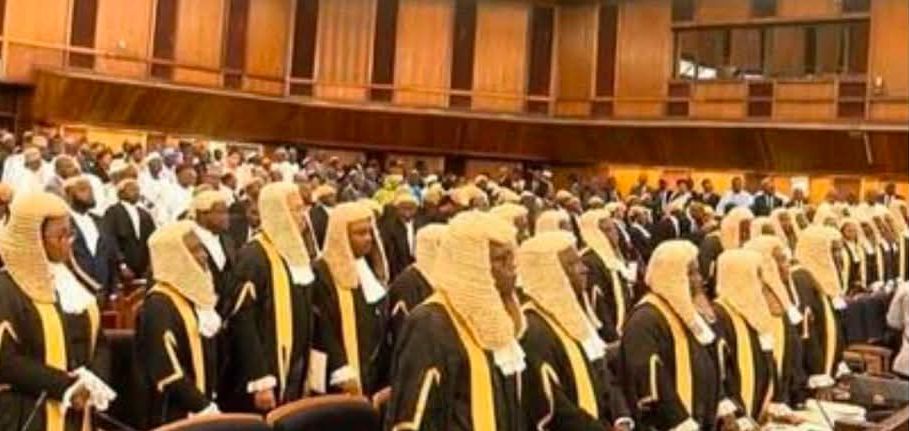
The Federal High Court has issued the (Pre-Election) Practice Directions, 2026, to ensure a fair, impartial, and expeditious determination of pre-election cases nationwide.
The new practice directions were issued by the chief judge, Justice John Tsoho, on Tuesday in a statement and also aim to ensure that, in all election matters, the parties focus on those genuinely at issue.
The statement said the directions would minimise the time spent dealing with interlocutory matters; ensure that the possibility of an amicable settlement is explored before the parties go into a hearing; and minimise undue adjournments and delays in the conduct of matters. In line with the constitution, the Electoral Act, 2026, and other applicable laws.
“The Federal High Court of Nigeria hereby notifies members of the Bar, political parties, litigants and the general public that the Honourable the Chief Judge of the Federal High Court, Honourable Justice John Terhemba Tsoho, OFR, has issued the Federal High Court (Pre-Election) Practice Directions, 2026. It is instructive that the current Practice Directions have repealed the 2022 version,” the CJ said.

According to a copy of the (Pre-Election) Practice Directions, 2026 attached to the statement, the provisions of the Federal High Court (Civil Procedure) Rules, 2019 shall apply to any issue not provided for in these Practice Directions.
“The court, in every pre-election matter before it, shall pay particular attention to the provisions of Sections 29 (5) (6) (7), 83 (5) & (6), 88 (1 4) of the Electoral Act, 2026 and Section 285 (14) (C) of the 1999 Constitution (as amended). A party challenging the conduct or outcome of a primary election shall join as respondents in the suit, all the relevant parties to enable the court to effectively determine the dispute,” it said.
It said that, in cognisance of pre-election cases being time-sensitive in nature, the registry of the court in all judicial divisions should be open on Saturdays, Sundays, and public holidays, between the hours of 10:00 a.m. and 2:00 p.m., exclusively for the filing of pre-election matters.
“Every pre-election matter shall be commenced by an Originating Summons as specified in Forms 3, 4 and 5 of Appendix 6 to the Federal High Court (Civil Procedure) Rules, with such variations as circumstances may require.
“Provided, however, that where a party alleges fraud, forgery or highly contentious facts in a pre-election matter, the parties shall, in addition to or in lieu of affidavits, set out the particulars of such alleged facts; which shall be examined by way of calling of witnesses viva voce or receiving of documents in evidence.
“The parties and the court shall be entitled to summon any person to attend, to produce documents before it, or to be examined or cross-examined before it in like manner at the hearing of the suit,” it said
To ensure speedy dispensation of justice, it said electronic mail and other electronic means may be used by the court to inform counsel of urgent court and case events. Besides, the practice directions allow a judge handling a pre-election matter to leverage technology in conducting proceedings, including virtual hearings.
“Upon the close of the exchange of processes between the parties, the court shall, within seven days, set down the matter for hearing. The court shall continue to accord priority to all pre-election matters until judgement is delivered.
“Where a matter comes up for hearing under these Practice Directions and either of the parties is absent, the court shall either suo motu or upon oral application by the counsel for the party present, order that the address of the party absent be deemed adopted if it is satisfied that the parties had notice of proceedings.
“The court and the parties shall prevent unnecessary delays and accordingly, not more than two adjournments shall be granted to any party to an action covered by the provisions of this Practice Directions,” it said, among other guidelines.