
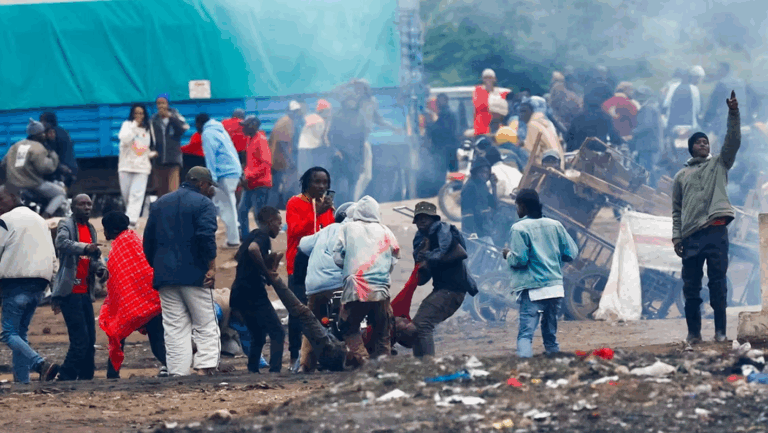
A government-appointed commission of inquiry on Thursday said at least 518 people were killed in the deadly violence that erupted after Tanzania’s October 29, 2025, election.
The government acknowledged last year that people died in the protest, but it did not provide the death toll. However, UN human rights experts had said that at least 700 people were estimated to have been killed in the violence.
The commission’s chair, Mohamed Chande Othman, while handing over the report to Tanzanian President Samia Suluhu Hassan, said the death toll could be underestimated due to challenges in identifying victims.

According to him, of the 518, 490 were males, 21 were children, and 16 were security officers.
Without specifically naming any individual, he said the commission’s “indisputable evidence” showed the violence that trailed the polls was sponsored by “trained people.”
“Organisers used various techniques, including using people without a deep understanding and desperate youth, while encouraging simultaneous acts of violence across different locations,” said Mr Othman.
Mr Othman recommended that a criminal investigation commission be set up to probe specific incidents, without passing judgment on law enforcement agencies.
Upon receiving the commission’s report, Ms Hassan said Tanzania had learnt from the violence that “shook our nation.”
“We have learnt,” said the president. “The commission has told us that all the violence was planned, coordinated, financed, and executed by people who were trained and given equipment for committing crimes.”
Ms Hassan maintained that the demonstrators’ aim was to “create a leadership vacuum” and make Tanzania “ungovernable.”
She accepted Mr Othman’s recommendation on the establishment of an investigation body to identify those responsible for the looting of properties and destruction of infrastructure.
“The investigation will also examine the deaths of children, address claims of missing bodies, and probe allegations of abductions, including cases beyond the immediate areas of the unrest,” she said.
However, the main opposition party, Chadema, dismissed the report as “a cover-up” and “an attempt to whitewash the regime’s crimes,” according to the AFP news agency.
Protests began on the election day, after opposition candidates Tundu Lissu of the CHADEMA party and Luhaga Mpina of the Alliance for Change and Transparency (ACT-Wazalendo) were barred from participating in the presidential and parliamentary elections. The protest lasted about two weeks.
Violence broke out after security operatives clashed with protesters. The police used firearms and tear gas against demonstrators in the cities of Dar es Salaam, Shinyanga, and Morogoro.
Despite the protests, Ms Hassan insisted that the East African country’s election was conducted with utmost “transparency and adherence to democratic principles.”
Meanwhile, the president, on December 2, 2025, justified the police’s killing of protesters. She accused demonstrators of attempting to overthrow her.
“So when we’re told that we used too much force in that event, what was the smallest force? Were we supposed to wait until the protesters—who had planned to overthrow the government—had succeeded?” she stated.
Tanzania’s Independent National Electoral Commission on November 1 declared Ms Hassan the winner of the controversial election, having garnered 98 per cent of the votes.