

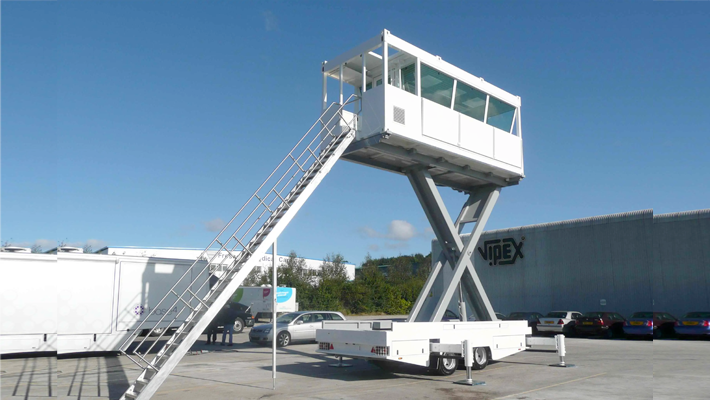
The Nigerian Airspace Management Agency says it has deployed a mobile control tower at Murtala Muhammed International Airport in Lagos following the Terminal 1 fire.
The director of Safety Electronics and Engineering Services, Terese Ihenacho, on Thursday, described the deployment as a significant operational milestone.
She said this was a swift and strategic response to the February 23 fire incident that affected critical air-ground communication infrastructure at the old terminal.

During the on-site inspection of the facility, Ms Ihenacho highlighted NAMA’s resilience and unwavering commitment to maintaining safe and efficient air navigation services in Nigeria’s busiest aviation hub.
She commended the dedication and technical expertise of NAMA officials, whose efforts ensured the tower’s timely delivery and operational readiness.
She further revealed that the control tower had been reconfigured to meet Nigeria’s unique operational demands, incorporating local innovations that enhanced efficiency and safety.
She noted the integration of a smart strip system alongside the traditional manual strip, reflecting a forward-looking approach to modern air traffic management.
She also disclosed that in a proactive move to further strengthen operational redundancy and safety, “NAMA has concluded arrangements to deploy a second Mobile Control Tower to service Runway 18R.”
However, Ms Ihenacho restated that the siting of the additional tower would be determined in collaboration with key aviation stakeholders, including air traffic controllers.
She identified other stakeholders, including the Nigerian Civil Aviation Authority, the Federal Airports Authority of Nigeria, and the Nigerian Meteorological Agency, to ensure optimal safety management.
She clarified that the mobile tower’s deployment formed part of NAMA’s broader contingency and resilience strategy.
She added that it was originally conceived as a backup solution to mitigate potential disruptions arising from infrastructure upgrades or environmental constraints affecting the main control tower.
Ms Ihenacho also disclosed that, beyond technical deployment, the agency had also implemented critical support infrastructure at the site.
She said this included enhanced solar-powered lighting, reinforced structural bracing to withstand environmental conditions, additional power supply systems, and comprehensive security coverage with CCTV surveillance.
Ms Ihenacho also highlighted ongoing efforts to improve the welfare and working conditions of air traffic controllers and technical staff operating at the temporary facility.
She noted that discussions were underway with relevant authorities to provide essential amenities and support services.
She commended the commitment of NAMA staff, describing them as “heroes” who worked tirelessly under challenging conditions, often at personal risk, to restore operational stability.
Ms Ihenacho stressed that the successful deployment of the Mobile Control Tower highlighted the agency’s unwavering dedication to the safety and efficiency of the Nigerian airspace.
(NAN)

