
Nigeria’s manufacturers pay between two and 10 times more than their counterparts in countries such as Vietnam and China for electricity, credit and logistics, putting the country’s factories at a major competitive disadvantage, the National Sugar Development Council has said.
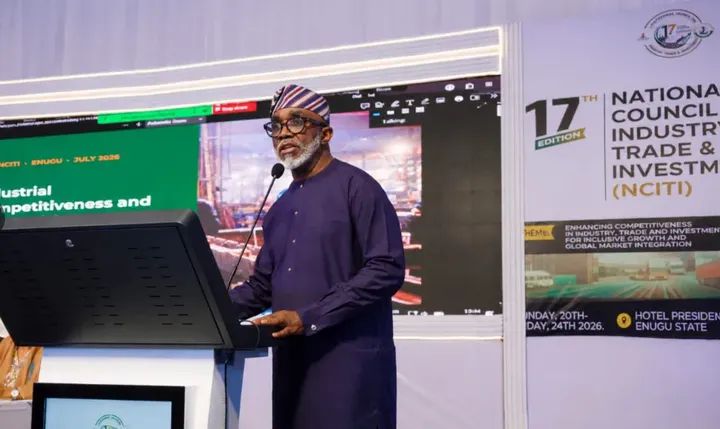
The Executive Secretary of the NSDC, Kamar Bakrin, disclosed this while presenting a paper at the technical session of the 17th National Council on Industry, Trade and Investment in Enugu.
This was contained in a statement made available to newsmen on Sunday.
Bakrin said the high cost of production, rather than weak demand, was the biggest challenge confronting Nigerian manufacturers.

“None of this is a demand problem. Nobody on this continent needs persuading to buy what Nigeria makes.
“It is a cost-of-production problem — and that distinction matters because costs, unlike demand, are within our power to fix,” he said.
According to him, industrial electricity costs about eight US cents per kilowatt-hour in Vietnam and around 10 cents in China, compared with about 15 cents on Nigeria’s national grid, rising to nearly 30 cents when manufacturers rely on diesel generators.
He added that Nigerian manufacturers spent an estimated ₦1.34tn generating their own electricity last year.
“Every factory in Nigeria is running a second, unwanted business as a private power station,” Bakrin said.
“Working capital costs 27 to 35 per cent in Nigeria against about 9 per cent in Vietnam and 3 per cent in China, while on the World Bank’s Logistics Performance Index, Nigeria ranks 88th out of 139 countries, compared with Vietnam’s 43rd and China’s 19th.
“The result: in a country of 230 million consumers, with duty-free access to 1.4 billion more under the African Continental Free Trade Area, manufacturing contributes barely 8 per cent of GDP, and capacity utilisation has slipped to 57.7 per cent,” the statement read.
He argued that the timing could not be more consequential.
“The government’s macroeconomic reforms have delivered stability — inflation roughly halved from its peak and reserves at $51bn, the highest since 2009 — giving factories, for the first time in years, the conditions to plan and invest.
“Global supply chains are being redrawn as companies diversify, and ‘a factory anchored in another country this decade will not move twice.’ And AfCFTA cuts both ways: ‘Either our goods are crossing borders going out, or everyone else’s goods are crossing ours coming in. We are either going to compete, or we are going to concede the market,” he said.