
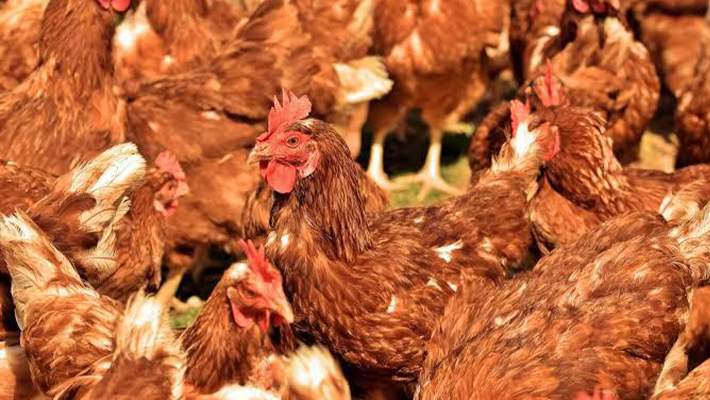
The federal government has introduced a newly developed chicken breed and 57 crop varieties to boost meat availability, enhance food security and improve Nigerians’ nutritional well-being.
This was announced in Ibadan on Thursday at the 36th meeting of the National Committee on Naming, Registration and Release of Crop Varieties, Livestock Breeds/Fisheries.
The meeting, organised by the National Centre for Genetic Resources and Biotechnology, was presided over by the chairman of the National Variety Release Committee, Soji Olufajo.

Mr Olufajo explained that the registration and release of the new chicken breed and the 57 high-yield varieties from 14 crops were based on recommendations from its two technical sub-committees.
He said that the new chicken breed and crop varieties would have a significant impact on food production in the country, advising farmers to take advantage of the opportunity by obtaining improved seeds and adapted materials.
Mr Olufajo called on agricultural extension agents to ensure that farmers were aware of new developments and upcoming initiatives to boost production in the country.
He charged research institutes, breeders, geneticists, and other stakeholders to continue doing what would enhance the growth and development of agriculture in Nigeria.
According to him, the new chicken breed is ‘Moorbeta’, while the crops comprise soyabean, yam, potato, onion, tomato, rice, pepper, eggplant, Musa spp, cotton, maize, groundnut, sorghum and cowpea.
Meanwhile, the technical sub-committee on naming, registration and release of the crop varieties, chaired by Shehu Ado, had, during its 40th meeting on Tuesday, deliberated on 59 varieties received.
The sub-committee, after deliberation and consideration of the 59 submissions, recommended 57 varieties, which were put before the NVRC for final approval at Thursday’s meeting.
Similarly, the technical sub-committee on naming, registration and release of livestock breeds/fisheries, during its 10th meeting on Wednesday, deliberated on the only new chicken breed received.
The sub-committee, chaired by Prof. Waheed Akin-Hassan, stated that the new chicken breed, ‘Moorbeta’, was a locally developed meat-type chicken.
He said there would be a mass production of the breed because of its great potential.
Mr Akin-Hassan noted that efforts to improve the performance of the nation’s indigenous chicken have been ongoing for a long time.
He commended all animal geneticists and breeders who contributed to the area, describing the new chicken breed as a mid-class type. Thereafter, the sub-committee put its recommendations before the NVRC for final approval.
The new chicken was bred by the Institute of Agricultural Research and Training, Ibadan. It was released and registered for its unique characteristics: high body weight at 10 weeks, good carcass characteristics, and tolerance to heat stress.
Among the new high-yield crop varieties released and registered are four Musa spp. varieties, comprising two plantains and two bananas, from the National Horticultural Research Institute, Ibadan.
The two new plantain varieties are HORTIPLAN 1 and 2, while the two new banana varieties are HORTIBAN 1 and 2. HORTIPLAN 1 and 2 were released for their heavy bunches, yellow pulp, excellence for boiling, frying, and roasting, flour-making, long shelf life, and high carotenoid content.
Meanwhile, HORTIBAN 1 and 2 were released and registered for their good sweet taste, thick peel, large pulp, and intermediate bract apex shape.
Also, one Soyabean from YSJ Limited and the International Institute of Tropical Agriculture, Ibadan, was released based on its good pod clearance, high protein content, and disease tolerance.
Two yam varieties, sponsored by the National Root Crops Research Institute, Umudike, Abia, in collaboration with IITA, Ibadan, were among the released crops. These two yam varieties were released based on early maturity, good pounding quality, and excellent boiling quality, among other qualities.
One potato variety (Connect) from the NRCRI was released for its large tubers, resistance to late blight, and suitability for table use.
Six onion varieties: HORTIONI 1, 2, 3 (dry season onion), and HORTIONI 4, 5, and 6 (wet season onion), from NIHORT, were also released. They were released for their high pungency, large bulb size, and disease resistance, among other traits.
Five varieties of tomato: HORTITOM 6 and 7, SP TOM 1, 2 and 3, from NIHORT, were also registered and released. They were released based on their heat tolerance, early maturity, disease resistance, and good adaptability to both dry and rainy conditions.
The five released rice varieties are FARO 73, SG rice 1 and 2, and MIP 5803 and 4802. They were from NCRI, Badeggi, Niger, the African Agricultural Technology Foundation, Abuja, and other foreign partners.
The NVRC approved the release and registration of the rice varieties for their long, slender grains, good tillering, and drought tolerance, among other benefits.
Furthermore, NVRC, during Thursday’s meeting, approved the release and registration of one Pepper variety—SP PEP 1, and three eggplant varieties: HORTICUM 1, 2 and 3.
Both the pepper and eggplant varieties from NIHORT were approved based on early maturity of 55-65 days (pepper) and early maturing eggplant.
Other crop varieties approved by the committee included 15 maize varieties, four groundnut varieties, 1 proprietary sorghum variety, four cowpea public varieties, and six proprietary cotton varieties.
(NAN)