
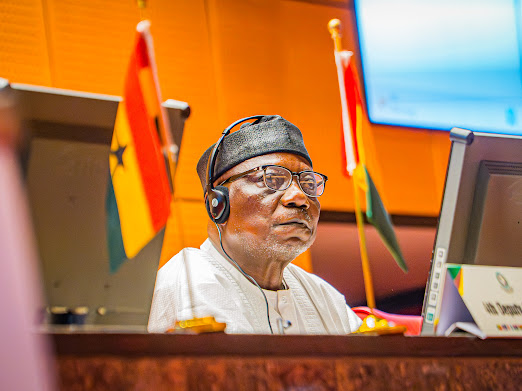
The Economic Community of West African States (ECOWAS) cannot put an end to the wave of military coups sweeping the region under the current multipolar global system, the bloc’s Commissioner for Political Affairs, Peace and Security has said.
Ambassador Dr. Abdel-Fatau Musah made the remark while presenting the outcome of regional consultations ahead of a special summit on the future of West African integration. He was responding to community lawmakers who wanted to know what would stop the recurring coups within the bloc.
Dr. Musah recalled that after the 2012 coup in Mali, ECOWAS intervened within days, successfully establishing a transition. Elections were held just over a year later, bringing Ibrahim Boubacar Keïta to power in 2013.
He stressed the need for a new compact to guide West African integration, noting that from 1992 to 2019, all regional presidents were elected through the ballot box. “If the military intervene, we have to choose them, not use force,” he said.

But the commissioner acknowledged that the geopolitical landscape has fundamentally changed.
“At that time, the threat of force alone was enough to bring any coup-hit nation back to the fold,” he explained. “Then, the United States was the only superpower. China was economically weak, Russia had disintegrated. There was multilateralism.”
He continued: “If ECOWAS said ‘we are suspending you, you have to hand over, otherwise you cannot go back’ – there was no country in the world to support the coup plotters. Not China, not Russia at that time. We had a unipolar world.”
According to Dr. Musah, the shift began with the assassination of Muammar Gaddafi in 2011. “That is when multipolarity dawned on Africa. It has moved on gradually, and today, if military people stage a coup, the US may say ‘we are against,’ China says ‘we support,’ and Russia says something different.”
As a result, he argued, “ECOWAS’ power under a multipolar system to force member states to hand over is limited. That is why it should be the role of the citizens in the country.”
Citizens’ power, not foreign democracy
Dr. Musah insisted that ECOWAS should never abandon democracy, but rejected the notion that democracy is a foreign culture.
“Africa had democracy long before the slave trade. Our democracy was far more advanced than many of these European countries. Again, our women were key decision-makers – all before this gender parity theory came up. You have it written all across West Africa.”
The commissioner said the region’s challenge is to adapt democracy to local needs. “First-past-the-post does not work. We have to look at it: how do you connect elections to development? In many of our countries, presidents are elected and then look forward to the next election – in between, virtually nothing is done.”
That disconnect, he warned, leads to a breakdown between citizens and government. “We need to empower citizens, women, young people. There is no way some of us would support a military coup.”
Kwaku Sakyi-Danso / EcowasNewsOnline.com