
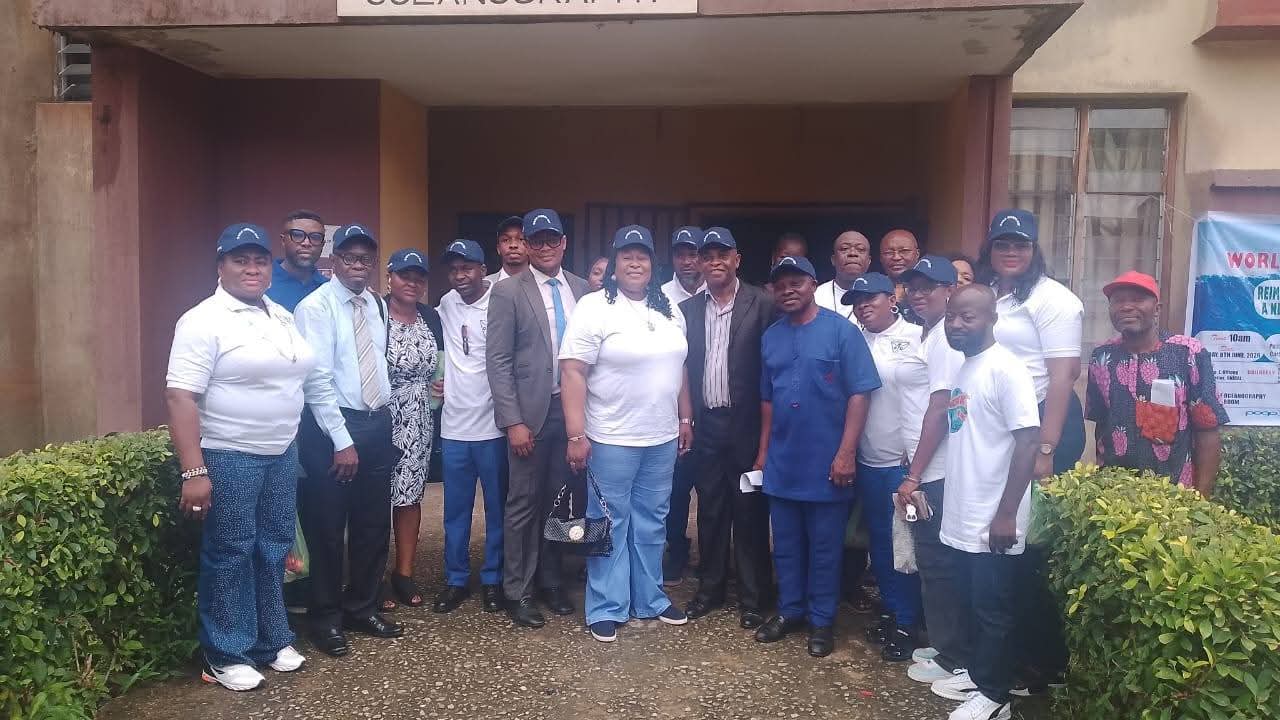
The Dean of the Faculty of Oceanography, University of Calabar (UNICAL), Prof. Francis Nwosu, has called on the Federal Government to significantly increase investment in marine science and manpower development to fully harness Nigeria’s vast ocean resources and strengthen the sustainability of coastal communities.
Prof. Nwosu made the appeal during the 2026 World Oceans Day celebration organised by the Faculty and Institute of Oceanography, UNICAL, with the theme “Reimagine: Beyond the World We Know – A New Relationship With Our Ocean.”
He described World Oceans Day as a global reminder of the need for nations to protect marine ecosystems while maximising their economic and environmental benefits for sustainable development.
According to him, the University of Calabar is positioning itself as a leading centre for marine research in Nigeria, but requires stronger government support in funding and provision of modern facilities to achieve its full potential.
The don warned that coastal cities face increasing environmental risks due to the effects of climate change driven by human activities, stressing the urgency of environmental protection and conservation.
He also urged the university management to prioritise marine science programmes and strengthen student training in order to position the institution to benefit from emerging opportunities in research, innovation and the blue economy.
Prof. Nwosu commended President Bola Ahmed Tinubu for establishing the Ministry of Marine and Blue Economy, describing it as a strategic policy step capable of unlocking Nigeria’s maritime potential if properly funded and implemented.
He, however, noted that Nigeria still has a long way to go in ocean exploration, lamenting that less than one percent of the country’s coastal waters have been properly harnessed despite the ocean covering about 71 per cent of the earth’s surface.
“The ocean remains highly resourceful, yet largely underutilised. Nigeria has not taken full advantage of its maritime domain for economic growth and food security,” he said.
Earlier in her remarks, the Director of the Institute of Oceanography, Dr. Philomena Edet Asuquo, said this year’s theme challenges stakeholders to rethink humanity’s relationship with the ocean and recognise its central role in sustaining life on earth.
She expressed concern over rising pollution and declining fish stocks, noting that coastal communities and fishermen are already feeling the impact on their livelihoods.
According to her, the state of the ocean is directly linked to human survival, livelihoods and future sustainability.
Dr. Asuquo emphasised that oceans provide food for billions, regulate global climate patterns, sustain biodiversity, and inspire scientific and cultural discovery, adding that their protection is a collective responsibility.
“Let us reimagine the ocean not as distant waters, but as a living system we are duty-bound to protect for present and future generations,” she said.
Also speaking, Guest Speaker, Engr. Henry Okoroego, Science and Technology Manager at Novel Ocean-Climate Innovation Hydro-Initiative, urged policymakers and stakeholders to integrate ocean conservation into national development planning.
He stressed that investment in ocean data systems, clean technologies and community-based monitoring would play a critical role in reversing environmental degradation and strengthening coastal resilience.
The event featured lectures, interactive sessions and discussions involving students, lecturers and stakeholders, focusing on marine biodiversity, climate change impacts and career opportunities within the blue economy sector.