
The Secretary to the Government of the Federation, George Akume, has said that former Vice President Atiku Abubakar was among political figures who supported the introduction of a rotational presidency in Nigeria following the annulment of the June 12, 1993 election.
Akume explained that the decision became necessary after the military government annulled the historic poll won by the late MKO Abiola, an action he described as a major setback to Nigeria’s democratic journey.
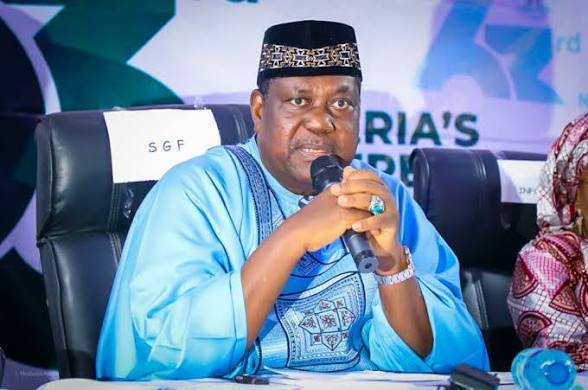
Speaking at a World Press Conference in Abuja to mark Democracy Day, the SGF, through his media aide Yomi Odunuga, said political leaders at the time were forced to take decisions aimed at preserving national unity and stabilising the country’s political direction.
He noted that leaders of the then Peoples Democratic Party, led by the late Chief Solomon Lar and Alhaji Adamu Ciroma, held strategic meetings in Kaduna where issues of zoning and power sharing were strongly discussed.
According to him, the idea of rotating the presidency between the North and South emerged after intense debate among stakeholders who were trying to manage the political tension created by the annulled election.
Akume stated that Atiku was present at one of such meetings and supported the consensus reached on rotational leadership.
“It was a difficult discussion before we agreed on rotation. Eventually, we had to accept it for national balance. The June 12 crisis complicated everything, but we agreed that power should alternate between North and South,” he was quoted as saying.
He further stressed that the arrangement was designed to promote inclusion and reduce political tension across regions.
The SGF also used the occasion to reflect on the significance of June 12, describing the annulled election as a painful moment in Nigeria’s democratic history and a clear expression of the people’s will.
He said the experience reinforced the principle that sovereignty belongs to the people and that their votes must always be respected.
Akume expressed confidence in Nigeria’s democratic institutions, particularly the Independent National Electoral Commission (INEC), noting that reforms and experience had strengthened the country’s electoral process since 1993.
He insisted that such an annulment could not easily happen again, adding that electoral actors today are more conscious of democratic responsibility.
The SGF also compared Nigeria’s democratic practice with other democracies, saying political actors should learn to accept both victory and defeat in elections.
He referenced examples such as former U.S. President Donald Trump and President Joe Biden, to illustrate the importance of respecting electoral outcomes.
Akume reaffirmed that Nigeria’s uninterrupted democratic rule since 1999 represents progress, stressing that freedom of expression and political participation remain key gains of democracy.
He urged political leaders to continue to respect democratic principles, strengthen institutions, and uphold the rule of law in the interest of national stability.
The SGF concluded that the lessons of June 12 remain central to Nigeria’s democratic evolution, especially the need to ensure that the will of the people is never undermined again.
Atiku Supported Power Rotation Agreement After 1993 Annulment, Says Akume
142