
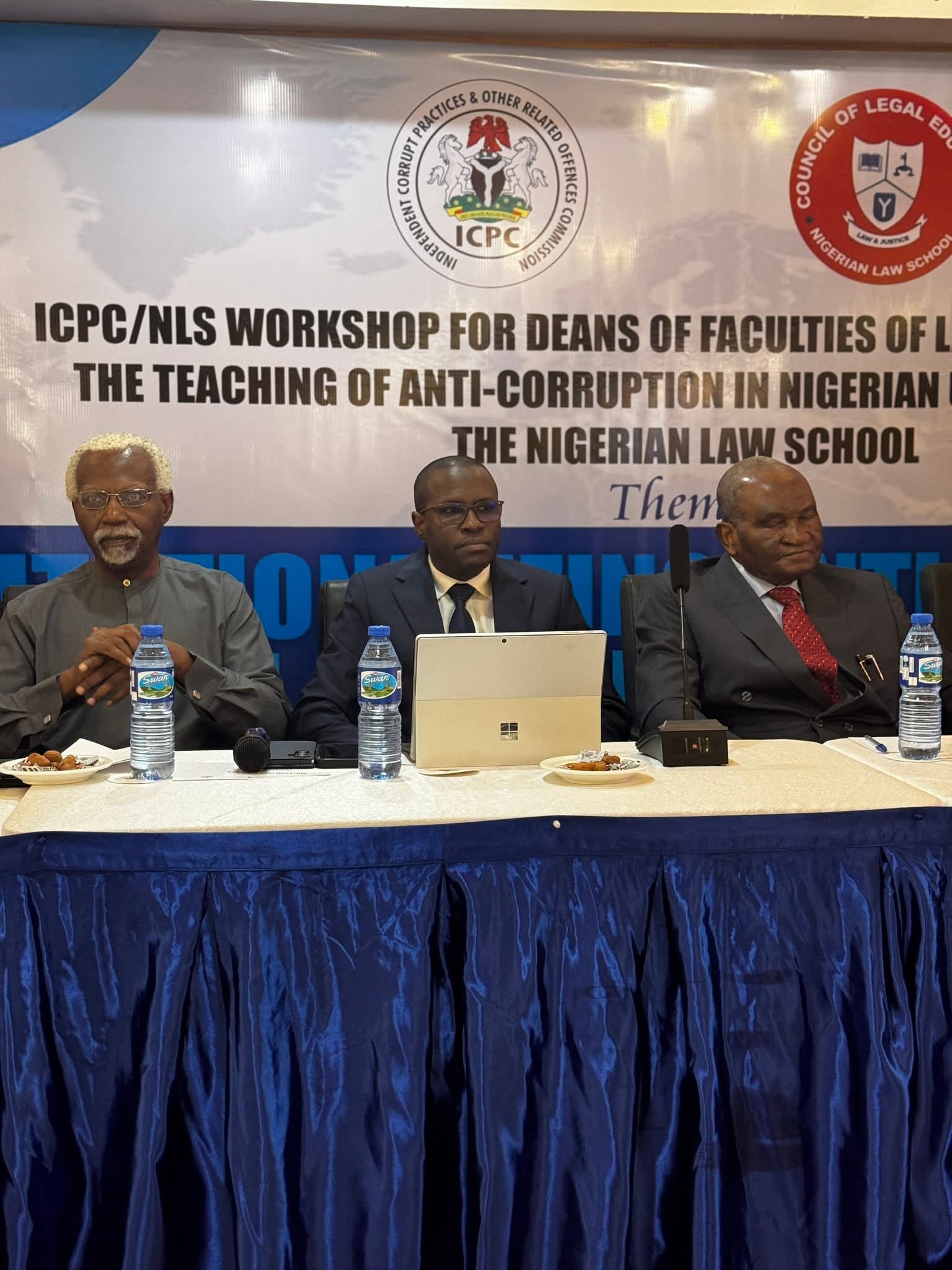
The Independent Corrupt Practices and related offences Commission (ICPC) and legal educators are collaborating to introduce ethics and anti-corruption studies into the Nigerian Law School and university law programmes.
The move formed part of discussions at the ICPC and Nigerian Law School workshop for deans of faculties of law, on Tuesday in Abuja.
The workshop, themed “Institutionalising Anti-Corruption Education in Nigerian Legal Training,” seeks to shape how future lawyers are trained on integrity and accountability.
The ICPC Chairman, Dr Musa Aliyu, SAN, said corruption continued to weaken institutions, undermine the rule of law, and erode public trust in Nigeria.

He argued that investigation and prosecution alone could not curb the menace, stressing that preventive and educational approaches were equally critical.
Mr Aliyu stated that shaping attitudes and strengthening ethical consciousness must begin at the formative stage of legal education.
He said lawyers, as custodians of the law and defenders of justice, occupied a central position in sustaining the rule of law and public confidence.
The ICPC chairman noted that the ethical grounding of legal practitioners directly influenced governance and institutional credibility.
He explained that integrating anti-corruption values into law curricula and professional training would produce lawyers who are intellectually competent and ethically grounded.
Mr Aliyu outlined ICPC’s three-fold mandate under the Corrupt Practices and Other Related Offences Act, 2000, to include: enforcement, prevention, and public education.
He said the workshop directly supported the commission’s preventive and educational mandate by preparing a generation of professionals to resist and challenge corruption.
The engagement, he said, would brainstorm on curriculum content, delivery models, and training methodologies for lecturers and facilitators.
”It will also strengthen collaboration between ICPC, universities, and the Nigerian Law School to reinforce the role of legal education in promoting transparency and accountability,” he said.
Mr Aliyu stressed that the framework would not be imposed, but would emerge from the collective wisdom and professional judgment of the deans present.
He urged participants to decide whether anti-corruption education should be infused across existing law courses, placed in general studies, or taught as a standalone subject.
The ICPC chairman pledged the commission’s support and institutional backing for whatever framework the academics adopt.
He described the initiative as a pilot that could extend to other professional disciplines if successful.
Mr Aliyu reaffirmed the ICPC’s commitment to building a legal profession that defends justice, integrity, and national development.