
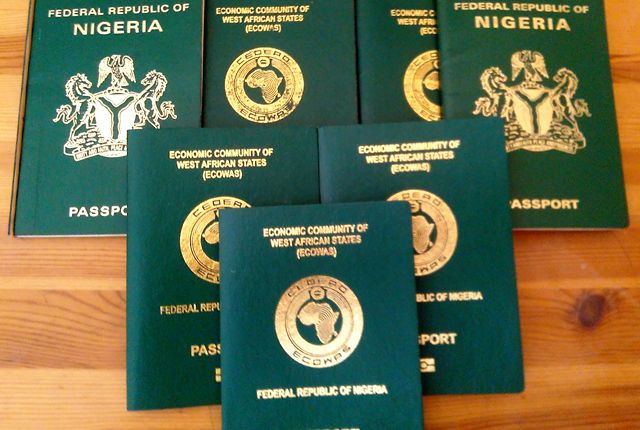
The Nigeria Immigration Service (NIS) has commenced the construction of a National Passport Booklet Manufacturing Centre aimed at ending Nigeria’s dependence on foreign countries for passport production.
The Minister of Interior, Dr Olubunmi Tunji-Ojo, announced this on Friday during the groundbreaking ceremony held at the NIS headquarters in Abuja.
Tunji-Ojo said Nigeria could no longer afford to rely on other countries for the production of sensitive national documents.
He explained that upon completion, Nigeria would become the first country in West Africa and the third in Africa to manufacture its passports locally.

The minister said the Federal Government was committed to establishing a world-class facility capable of producing passports that meet the highest international standards.
He added that the initiative would not only end Nigeria’s dependence on foreign passport manufacturers but also position the country as an exporter and supplier of passport booklets to other nations.
According to him, Nigeria requires approximately two million passports annually, but the proposed facility would have the capacity to produce six million booklets yearly by May, with plans to increase production to 10 million.
He said Nigeria, as Africa’s largest economy, would be positioned to lead the market, allowing other African countries to obtain their passports from Nigeria rather than sourcing them from Europe and the Americas.
Tunji-Ojo also highlighted the employment opportunities the project would create, stressing that local production would help retain jobs and economic benefits within the country.
“We cannot be aiding employment in other countries while creating unemployment in our own country,” he said.
The minister maintained that every stage of the Nigerian passport process, including booklet manufacturing, biometric capturing, application, processing, approval, personalisation, production and issuance, would be handled in Nigeria by Nigerians.
He expressed confidence that the establishment of the factory would provide employment opportunities and enable families to earn a living through the project.
Tunji-Ojo commended President Bola Tinubu for his commitment to strengthening and improving the NIS, as well as other sectors under the Ministry of Interior and the country at large.
Speaking at the ceremony, the Comptroller-General of the NIS, Kemi Nandap, said the centre would establish a more secure, reliable and self-sufficient passport system for Nigeria.
She described passports as highly important documents, noting that they represent opportunities, mobility and a sense of belonging for citizens, while symbolising sovereignty, responsibility and trust for the Nigerian state.
Nandap stressed that the security, integrity and availability of passports should not be treated as ordinary administrative matters.
She said the locally established centre would help address delays and prolonged waiting periods experienced by Nigerians due to shortages of passport booklets.
The NIS chief cited cases of students unable to meet admission deadlines abroad because of passport delays and parents who could not travel to reunite with their children overseas.
According to her, such experiences demonstrated the need for Nigeria to exercise control over critical aspects of its passport supply chain.
She explained that the challenge was not merely about increasing the number of available booklets but creating a more dependable and sustainable passport production system.
Nandap said the facility would give the Immigration Service greater control over passport production and provide Nigerians with a more reliable system built on security, national sovereignty and local economic value.
She added that the success of the project would not be determined by the size of its buildings or offices but by the level of security, operational efficiency and public confidence it delivers.
The Comptroller-General said the service owed Nigerians more than ambitious projects, emphasising the need for effective implementation and measurable results.
She assured that the NIS would collaborate with the Ministry of Interior, contractors, technical partners, vendors and oversight agencies to ensure the project was executed professionally, transparently and with integrity.
Nandap also acknowledged President Tinubu’s continued support for the service, saying the pace of reforms and their implementation had increased significantly under his administration.
(NAN)