
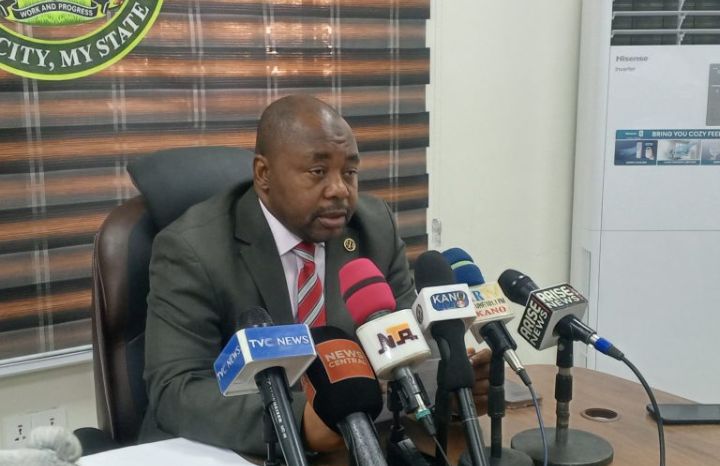
The Chairman of the Kano State Multi-Agency Taskforce on Drug Abuse and Illicit Trafficking, Muhuyi Magaji Rimingado, has accused the Pharmaceutical Council of Nigeria (PCN) of allegedly shielding drug dealers and facilitating the distribution of illicit substances in Kano State.
Rimingado made the allegations while addressing journalists in Kano, where he expressed concern over what he described as the involvement of some public officials in activities that undermine the state’s efforts to combat drug abuse and illicit drug trafficking.
The task force chairman said the fight against drug abuse in Kano had reached a critical stage requiring decisive measures against individuals and institutions allegedly using their public positions to create an enabling environment for illegal drug trafficking.
According to him, the task force would no longer concentrate exclusively on arresting drug users while individuals and organisations allegedly responsible for supplying the substances continued to enjoy protection from regulatory authorities.

Rimingado said pregabalin and other controlled substances remained among the most widely abused drugs in Kano State, adding that the situation required regulatory agencies to discharge their responsibilities with patriotism, professionalism and fear of Allah.
He argued that if regulatory institutions performed their statutory duties effectively, there would be little need for the state government to establish additional mechanisms to confront the growing problem of drug abuse.
The chairman disclosed that the task force had recorded 1,760 arrests since the commencement of its operations, with 890 suspects convicted for various drug-related offences.
He further stated that 63 suspects were awaiting trial, while approximately 690 convicted persons were being held in various correctional facilities.
Rimingado explained that other offenders had either been referred for rehabilitation, fined or sentenced to community service, describing the figures as evidence of the task force’s extensive efforts towards reducing drug demand, disrupting supply networks and confronting thuggery.
He maintained that the task force’s strategy recognised the direct relationship between drug abuse and the activities of street gangs and thugs, stressing that tackling the supply chain was essential to achieving sustainable results.
However, Rimingado said the task force could not continue arresting drug users without confronting those allegedly responsible for making the substances available to them.
He specifically accused some regulatory officials of shielding drug dealers despite having statutory responsibilities to prevent unauthorised access to controlled pharmaceutical products.
The task force chairman recalled the recent seizure of 3.18 million pregabalin capsules by the agency, describing the development as an indication of the scale of the drug distribution problem confronting Kano State.
According to Rimingado, eight out of every 10 suspected drug users arrested in Kano were either found in possession of pregabalin or confessed to abusing the substance.
He questioned the circumstances surrounding the issuance of import licences to pharmaceutical companies dealing in pregabalin, particularly following its rescheduling as a controlled drug by the National Agency for Food and Drug Administration and Control (NAFDAC) on September 14, 2026.
Rimingado wondered what regulatory data informed the issuance of import licences to several companies, alleging that some businesses had exploited the privileges granted to them to facilitate the distribution of controlled substances.
In what he described as findings from preliminary investigations, Rimingado alleged that an import licence granted to UGO Lab Production Nigeria Limited on October 23, 2026, was part of a wider network of companies allegedly involved in the unlawful distribution of pregabalin.
He claimed that investigations revealed that the owner of UGO Lab Production Nigeria Limited had also established another company known as SEEMARK Pharmaceutical Nigeria Limited, which he alleged was created as a front for clandestine drug distribution activities.
The task force chairman further accused the Pharmaceutical Council of Nigeria of facilitating the alleged activities by registering a property at No. 10 Apple Avenue, which he described as a purely residential location, for pharmaceutical operations.