
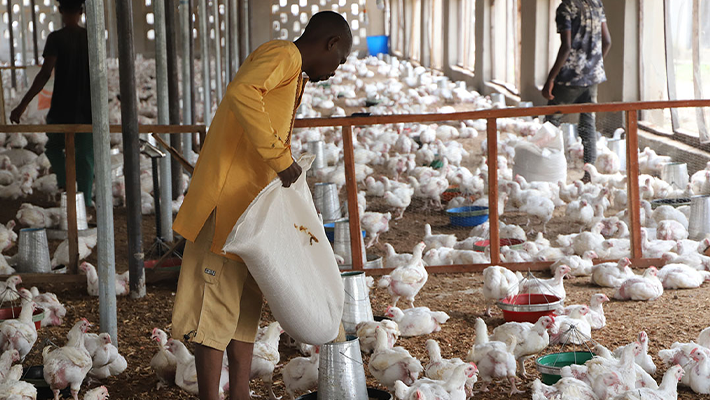
Some small-holder poultry farmers in the North-East have called on the government at all levels to intervene and save the sub-sector from imminent collapse.
In separate interviews with journalists on Sunday in Borno, Yobe and Adamawa, poultry farmers described rising input costs as a serious threat to productivity.
Godwin Dedan, a farmer and dealer in poultry feeds and medicines, called for targeted government interventions to address the challenges facing small-scale producers.
He said rising feed costs remain a major concern and require government support for local production of essential feed ingredients.

“Such interventions could include subsidising poultry feed ingredients, supporting local production of maize and soybean, and establishing affordable feed-milling facilities,” he said.
Mr Dedan also called for low-interest loans and grants to enable small-holder farmers to purchase day-old chicks, feeds, vaccines and other essential inputs.
He said sustained government support, improved market access and affordable production inputs were necessary to keep small-holder farmers in business.
Haruna Ismail, a grower of between 50 and 100 birds in Yola-South, said the price of day-old chicks had increased from between N980 and N1,050 in 2025 to the current N2,270.
He added that a bag of poultry feed, previously sold between N16,000 and N18,000, now costs between N21,600 and N23,000.
Mr Ismail said the cost of poultry medicines also increased, with some sachets previously sold for between N400 and N800 now costing between N1,800 and N2,000.
He said the situation has forced him to reduce the number of birds he buys and adjust spending on feed and medications.
Another farmer in Yola-North, Peace Samuel, said that rising production costs have made poultry farming increasingly unsustainable.
“After rearing birds for six to seven weeks and feeding them at such high costs, it will be fair to sell at N20,000 each. But some people may prefer to buy beef for N10,000 instead of chicken,” she said.
Ms Samuel identified disease outbreaks, including coccidiosis, Newcastle disease and Gumboro, as additional challenges confronting poultry farming.
According to her, delayed treatment of infections could result in high bird mortality and significant financial losses.
In Biu, Borno, smallholder poultry farmers also appealed to the state and federal government to support them in unlocking the numerous job opportunities in the subsector.
Shettima Isa, another poultry farmer in Tum, said a bag of feed was selling for N18,000, up from N10,000 previously.
“This is increasingly becoming unbearable because you will spend huge money on feeds and vaccines and end up selling the broiler for between N8,000 and N12,000 depending on their sizes.
“We hardly make enough profit, and so many stopped the business, and many jobs were lost too because it’s a value chain.
“If the government will support poultry farmers in Biu and in the entire state, we will have more jobs created and have more food for Nigerians,” he said.
Usman Kabiru, another poultry farmer in Biu town, said he was forced to abandon poultry farming in view of the high cost of feeds and poor pricing.
Mr Kabiru, however, said that if the government supported them by subsidising feeds and other inputs, he might reconsider reinvesting in the business.
A Potiskum-based poultry farmer in Yobe, Isa Bawa, noted that poultry feed prices have increased significantly over the last five years.
“As of four to five years back, the price of a sack of poultry feed was between N5,000 and N7,000 but gradually reached N23,000 for starter and N21,000 for finisher,” he said.
Another poultry farmer in Potiskum, Usman Maidede, said the high cost of feed had reduced the number of poultry farmers in the area, a situation that sometimes led to scarcity of eggs and birds.
“When the price is high, the farmers rear less, which in turn causes less availability for the buyers,” Mr Maidede said.
(NAN)