
…warns ECOWAS against “shifting the goalpost”
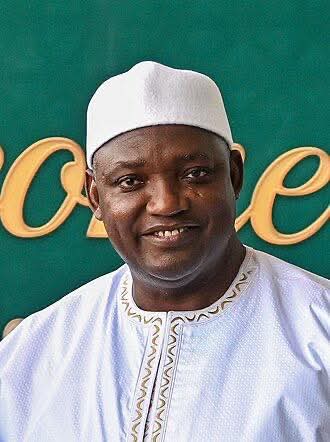
Fresh concerns over democratic backsliding and constitutional manipulation in West Africa have resurfaced at the ongoing ECOWAS Parliament session in Abuja after Sierra Leonean lawmaker, Saa Emerson Lamina openly questioned Gambian President Adama Barrow’s pursuit of a possible third term in office.
Hon. Lamina, who serves as Leader of Government Business Two in Sierra Leone’s Parliament, spoke during discussions following the presentation of country reports by The Gambia, Ghana, and Côte d’Ivoire at the 2026 First Ordinary Session of the ECOWAS Parliament holding in Abuja.
While commending The Gambia for progress in democratic governance and early warning systems, Lamina expressed skepticism over what he described as a growing pattern among African leaders who campaign on reform and constitutionalism but later attempt to extend their stay in power.

“Leaders in West Africa must not shift the goalpost in the middle of the game,” Lamina said. “That is a red flag.”
His comments come against the backdrop of mounting regional anxiety over constitutional amendments and prolonged presidencies — developments analysts say have contributed to political instability and military takeovers across parts of West Africa in recent years.
The concern surrounding President Barrow’s political future stems largely from the failure of constitutional reform efforts in The Gambia following the end of former ruler Yahya Jammeh’s 22-year rule.
After Jammeh was removed from power in 2017 following a disputed election and regional pressure led by ECOWAS, many Gambians expected sweeping democratic reforms, including presidential term limits aimed at preventing another prolonged presidency.
However, efforts to adopt a new constitution collapsed in 2020 after disagreements emerged over whether term limits should apply retroactively to incumbent President Barrow.
As a result, the 1997 Constitution introduced during Jammeh’s administration — which permits unlimited five-year presidential terms — remains in force.
That constitutional vacuum has fueled growing suspicion among critics who accuse Barrow of abandoning earlier reform promises.
In January 2025, Barrow publicly confirmed his intention to seek re-election in the 2026 presidential polls, effectively opening the door to a potential third term.
For Lamina, the issue goes beyond domestic Gambian politics and strikes at the heart of democratic credibility within the sub-region.
“I detest and do not admire leaders that campaign on the rules of two terms but later become different with third-term ambitions or limitless tenure,” he stated.
The Sierra Leonean lawmaker warned that prolonged presidencies and constitutional inconsistencies often create fertile ground for military intervention — a phenomenon ECOWAS has struggled to contain in countries such as Mali, Burkina Faso, and Niger.
Still, Lamina emphasized that he does not support military coups, arguing that juntas often suppress the media, suspend constitutions, and weaken democratic institutions.
Instead, he called for stronger regional democratic safeguards and harmonized constitutional standards across ECOWAS member states.
Citing Article 40.2 of ECOWAS protocols, Lamina argued that West African nations should work toward uniform democratic principles, including consistent presidential term limits.
“We already have common electoral principles in some areas,” he said. “For example, most countries now respect the ECOWAS protocol preventing electoral law changes close to elections. Uniform laws can strengthen democracy across the region.”
Lamina also questioned the fragmentation of political parties in The Gambia, describing it as excessive for a country with a relatively small population.
“There should be stronger thresholds before political parties are allowed to contest,” he argued.
Despite his concerns, Lamina praised The Gambia’s early warning mechanisms and acknowledged the country’s relative openness compared to several states in the region.
The Gambian country report presented to ECOWAS Parliament noted that authorities continue monitoring political tensions ahead of the December 2026 elections, particularly at the community level where localized disputes could emerge during campaigning.
Known as the “Smiling Coast of West Africa,” The Gambia is Africa’s smallest mainland country and is almost entirely surrounded by Senegal except for its Atlantic coastline. The nation of over 2.4 million people is culturally renowned for griot storytelling traditions and the kora musical instrument, while politically it remains in a delicate democratic transition nearly a decade after Jammeh’s departure from power.