
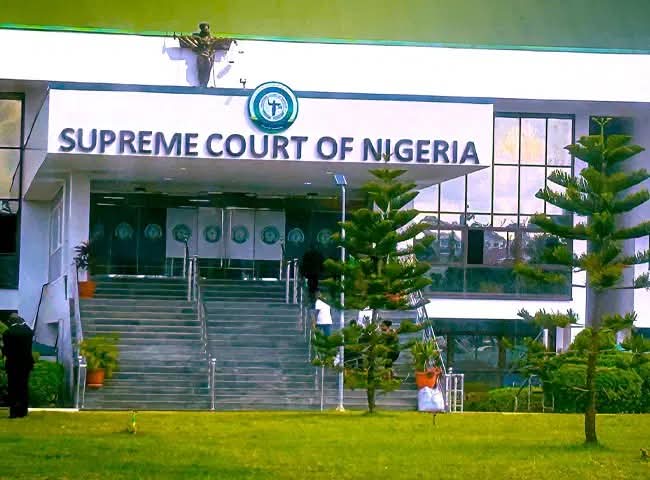
The Supreme Court on Monday dismissed an appeal seeking the dissolution of the merger between Providus Bank Limited and Unity Bank Plc. A five-member panel of the apex court, in a unanimous judgement delivered by Justice Tijani Abubakar, dismissed the appeal seeking to overturn the judgement of the Court of Appeal, for lacking in merit.
The appellants, Suleiman Abubakar and Mohammed Goni Modu, who are customers and shareholders of the banks, had appealed against the appellate court judgement. They named Providus Bank, Unity Bank, PAC Capital Limited, Vetiva Advisory Services Limited, Lighthouse Capital Limited, Planet Capital Limited, and the Corporate Affairs Commission as first to seventh respondents.
They also listed the Federal Competition and Consumer Protection Commission, the Securities and Exchange Commission, and the Central Bank of Nigeria as the eighth, ninth, and 10th respondents, respectively, in the appeal marked SC/CV/132/2026.
The Supreme Court, after dismissing the case of the appellants, subsequently invoked its powers under Section 22 of the Supreme Court Act to directly sanction the merger between Providus Bank Limited and Unity Bank Plc. The decision accordingly brought respite to customers and shareholders of the banks, as the judgement effectively drew the curtain on litigation surrounding the merger.

As part of efforts to comply with the Central Bank of Nigeria’s recapitalisation policy, Providus and Unity Banks had approached the Federal High Court in July 2025. The two banks sought an order to convene separate meetings of their respective shareholders and directors to consider and approve a scheme of merger between the two.
Following the court’s order, Providus and Unity Banks held separate meetings and approved the scheme of merger. The meeting also led to the trial court sanctioning the scheme.
Dissatisfied, the two appellants, despite not being parties to the scheme of merger, approached the trial court seeking leave to bring an application as interested parties and for an order dissolving the merger of the two banks. After granting leave for the appellants to be joined as interested parties, the trial court then ordered that the appellants’ application would be determined first before the motion of the respondents.
Dissatisfied, the appellants (Messrs Abubakar and Modu), who are customers and shareholders of the affected banks, approached the Court of Appeal to challenge the trial court’s decision.
However, the appellate court dismissed their case on March 6 and ordered an accelerated hearing and determination of the suit before the trial court, with costs against the appellants. Not satisfied, the appellants again approached the apex court to have the lower court’s order overturned.
However, the Supreme Court, in a unanimous judgement, held that the appeal was unmeritorious and accordingly dismissed, with a cost of N10 million each in favour of the respondents. The judgement was delivered in Appeal No. SC/CV/132/2026, arising from Appeal No. CA/LAG/CV/137/2025 and Suit No. FHC/L/MISC/734/2025.
Subsequently, the panel invoked Section 22 of the Supreme Court Act to directly sanction the merger between Providus Bank and Unity Bank, effectively bringing to a close all litigation surrounding it.
The apex court further ordered the transfer of all assets, liabilities, and undertakings, including the real properties of Unity Bank Plc, to Providus Bank Limited, in accordance with the approved scheme of merger.
Justice Abubakar, in addition, ordered that the transfer be completed within 10 days of the sanction of the scheme. As part of the merger arrangements, the apex court approved a consideration of N3.18 per share or 18 Providus Bank shares of 50 kobo each for every 17 Unity Bank shares held by shareholders.
The court also ordered the dissolution of the board of Unity Bank Plc without winding up the institution and approved the adoption of the new name, Providus-Unity Bank Limited, for the enlarged entity.
Reacting to the apex court verdict, counsel to Unity Bank, Damian Dodo, alongside Reuben Atabo, SAN, described the ruling as a historic decision that had finally settled all disputes relating to the merger. According to Mr Dodo, the Supreme Court’s intervention had removed all legal obstacles to the consolidation.