By Abasi Ita
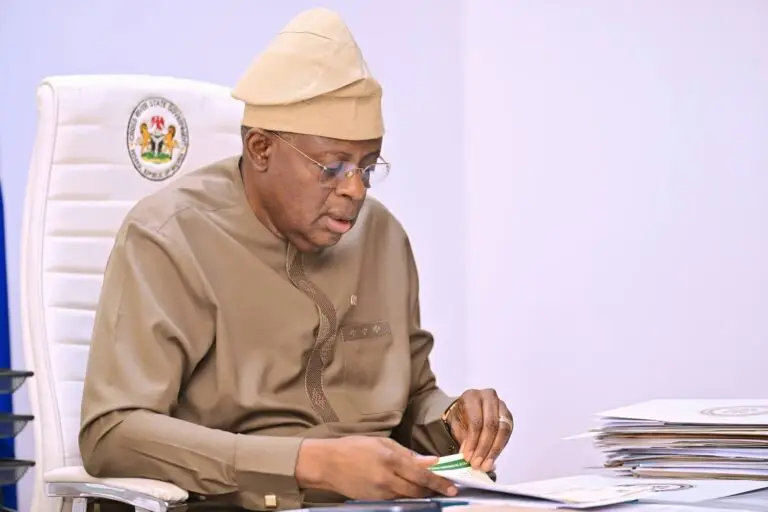
Cross River Governor, Prince Bassey Otu, has proposed a N987.8 billion budget for the 2027 fiscal year, with infrastructure, education and healthcare receiving the largest allocations.
Tagged Budget of Consolidation and Renewed Hope, the proposal was recently presented to the Cross River State House of Assembly in Calabar.
Otu described the budget as more than an aggregation of figures, calling it a solemn commitment to fulfilling the people’s expectations and improving their livelihoods.
Infrastructure received the highest allocation of N246.1 billion, followed by education with N99.6 billion and health with N85.4 billion. Agriculture was allocated N28.2 billion, while aviation received N21.8 billion.
Other allocations include N20.2 billion for the House of Assembly, N19.1 billion for the judiciary, N16.6 billion for power, N11.3 billion for tourism, and N10.8 billion for Special Duties and Intergovernmental Relations.
Science, Technology and Innovation received N6.1 billion, while the ministries of Information and Women Affairs were allocated N4.7 billion each.
The governor said the proposed budget represents a 2.57 per cent increase over the 2026 fiscal year’s budget.
Capital expenditure accounts for N708.43 billion, representing 71.72 per cent of the total, while recurrent expenditure stands at N279.38 billion, or 28.28 per cent.
Otu identified federal allocations, grants from international organisations and donor agencies, internally generated revenue, loans, proceeds from the sale of moribund state assets and reserve funds as potential sources of financing the budget.
He explained that the proposal was aligned with the United Nations Sustainable Development Goals to ensure continuity in the execution of ongoing and uncompleted projects.
Addressing concerns about the state’s debt profile, Otu maintained that his administration had not obtained fresh domestic or external loans since assuming office in 2023.
Citing the National Bureau of Statistics and the Debt Management Office, he said Cross River remained among the states that had not contracted new loans, attributing the existing debt burden to obligations inherited from previous administrations.
”I cannot, and will never mortgage the future of our children with unsustainable loans,” he declared.
The governor pledged to strengthen internally generated revenue, maximise federal allocations and attract development assistance and private investment to finance critical projects without imposing unsustainable debt on the state.
He also promised to sustain road and bridge construction while reviving moribund industries to stimulate economic growth and create employment opportunities.
On education, Otu reaffirmed his administration’s commitment to free and compulsory education from primary to junior secondary school, alongside the payment of West African Examinations Council fees for students in public schools.
He said technical and vocational education would receive priority to equip young people with practical skills and encourage entrepreneurship.
”Funds have been provided in the 2027 budget for the reconstitution of the State Scholarship Board and reintroduction of bursary payment and special allowances to indigenous medical students,” he disclosed.
In the health sector, the governor said the government would prioritise the procurement of modern medical equipment and essential consumables to reduce infant and maternal mortality.
He also announced plans to transform CallyAir into a profitable and self sustaining revenue generating asset, with provisions in the budget to pursue an independent Air Operator Certificate.
Otu assured residents that his administration would remain responsive, prudent and accountable in the management of public resources.
He stressed that sustained cooperation among the executive, legislature and judiciary was essential to maintaining peace and stability while advancing the state’s development and shared prosperity.
2027: Otu Proposes N987.8bn Budget, Prioritises Infrastructure, Education, Health
10