
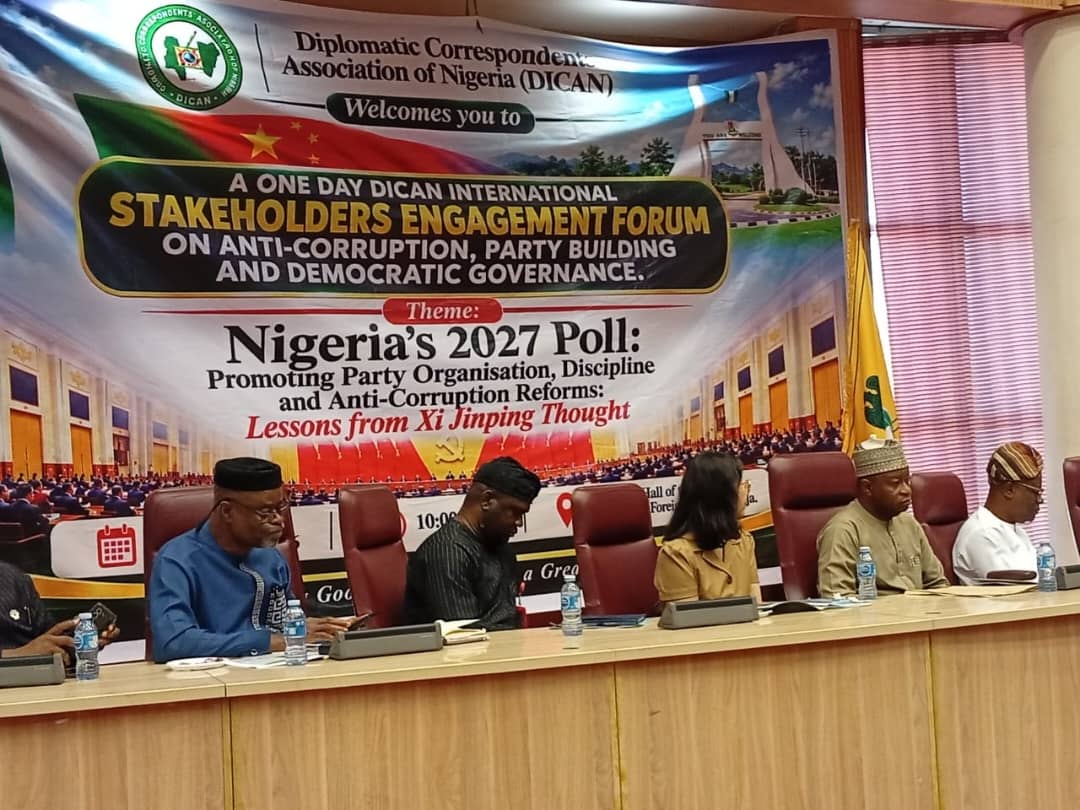
China has reaffirmed its commitment to tackling corruption, revealing that 8.1 million cases have been filed against officials since 2012, while expressing readiness to share its governance experience with Nigeria ahead of the 2027 general elections.
Chinese Counsellor, Dong Hairong, disclosed this at the International Stakeholders Engagement Forum on Anti-Corruption, Party Building and Democratic Governance organised by the Diplomatic Correspondents Association of Nigeria (DICAN) in Abuja.
Hairong said more than 7.9 million officials had faced disciplinary and administrative sanctions under China’s anti-corruption campaign, including over 900 officials at ministerial level and above.
She said the campaign was based on zero tolerance, full coverage and no exceptions, adding that public support for the initiative had risen to 97.4 per cent.

According to her, the Chinese experience demonstrates that fighting corruption requires strong political commitment, effective supervision of public officials and consistent enforcement of institutional rules.
She explained that the Communist Party of China had continued to strengthen its internal governance through strict discipline, leadership accountability and measures designed to prevent abuse of power.
Hairong also referred to the Fifth Plenary Session of the 20th Central Committee of the Communist Party of China, held in Beijing from October 26 to 29, 2026, which adopted measures to strengthen party self-governance and improve institutional effectiveness.
She said China was prepared to deepen exchanges with Nigeria on anti-corruption, party organisation, public administration and the protection of citizens’ interests.
In a goodwill message delivered by Mahmud Aliyu, Assistant Director of Administration at the Ministry of Foreign Affairs, the Minister of State for Foreign Affairs, Sola Enikanolaiye, described anti-corruption and party-building as essential foundations for democratic consolidation.
He said the issues were directly connected to Nigeria’s national development aspirations, stressing that strong institutions, transparency, accountability and inclusive political participation were necessary for effective governance.
The minister noted that democracy should not be limited to periodic elections but must also guarantee fundamental freedoms, institutional checks and balances and responsive leadership.
He urged stakeholders to support the realisation of Nigeria’s 4-D foreign policy priorities of Demography, Development, Diaspora and Democracy, noting that political parties, the media, civil society and government institutions had important responsibilities in the process.
Also addressing the gathering, the Campaign Spokesperson of the National Democratic Congress (NDC), Dr Chiogo Constance Ikokwu, said Nigeria needed a political system in which public office was treated as a public trust rather than a prize to be captured.
Ikokwu, a former journalist with over two decades of experience, said her transition from journalism to partisan politics had given her a deeper understanding of the challenges confronting the country’s political system.
She criticised the weakness of internal democracy in political parties, arguing that parties could not credibly promise Nigerians democratic governance while denying their members the opportunity to participate freely in internal decision-making.
She called for transparent party primaries, respect for party constitutions and an electoral system that would inspire public confidence.
With the 2027 elections approaching, she warned that voter apathy could create opportunities for electoral manipulation if citizens lost confidence in the process.
Ikokwu also called for greater inclusion of women in political leadership, insisting that women must participate in decision-making rather than being restricted to election campaigns and mobilisation.
The National Chairman of the Inter-Party Advisory Council (IPAC) and Allied Peoples Movement (APM), Dr Yusuf Mohammad Dantalle, called for stronger political parties anchored on discipline, ideological clarity and internal democracy.
He said weak political party structures could undermine democratic governance, while corruption weakened public institutions, discouraged investment and deprived citizens of development benefits.
Dantalle urged political parties to embrace financial transparency, accountable campaign financing and effective codes of conduct for political actors.
He described China’s experience in party discipline and anti-corruption as an opportunity for comparative learning, stressing that Nigeria could adopt useful institutional practices without abandoning its democratic principles.
He reaffirmed IPAC’s commitment to working with government institutions, anti-corruption agencies, civil society and international partners to promote ethical political practices.
Earlier, DICAN Chairman, Idehai Frederick, said the forum was designed to provide a platform for policy dialogue and exchange of ideas on strengthening Nigeria’s democratic institutions ahead of the 2027 polls.
Frederick said the quality of the elections would depend not only on activities on election day but also on the strength of political parties, credibility of institutions, responsible leadership and citizens’ participation.
He clarified that Nigeria’s interest in China’s governance experience was not an endorsement of its political system, noting that Nigeria remained committed to constitutional multiparty democracy.
He said the forum would enable participants to identify practical lessons in institutional discipline, accountability, anti-corruption and long-term development planning that could be adapted to Nigeria’s political environment.
In a presentation titled Nigeria’s 2027 Poll: Promoting Party Organisation, Discipline and Anti-Corruption Reforms — Lessons from Xi Jinping Thought, the Founding Executive Director of the African Centre for Leadership, Strategy and Development (Centre LSD), Dr Otive Igbuzor, identified weak party institutionalisation, ideological deficiencies, manipulation of primaries and monetisation of elections as major challenges to Nigeria’s democracy.
Igbuzor argued that political parties must move beyond serving as electoral platforms for political interests and become organised institutions capable of developing leaders, formulating policies and promoting public accountability.
He identified ideological clarity, party discipline, sustained anti-corruption efforts, people-centred development and leadership development as important lessons from China’s experience.
However, he cautioned against adopting China’s political structure, emphasising that Nigeria’s reforms must preserve multiparty competition, political freedom, judicial oversight and constitutional accountability.
He proposed reforms covering party organisation, internal democracy, political financing, anti-corruption mechanisms, electoral integrity and leadership training.
Igbuzor further argued that the fight against corruption must address structural inequalities and political patronage, noting that stolen public resources translate into lost opportunities in education, healthcare, employment and infrastructure.
The forum, held at the Rotunda Hall of the Ministry of Foreign Affairs, Abuja, attracted diplomats, political party leaders, representatives of anti-corruption agencies, civil society organisations, academics and media practitioners.