
By Lukman Laleye Babalola
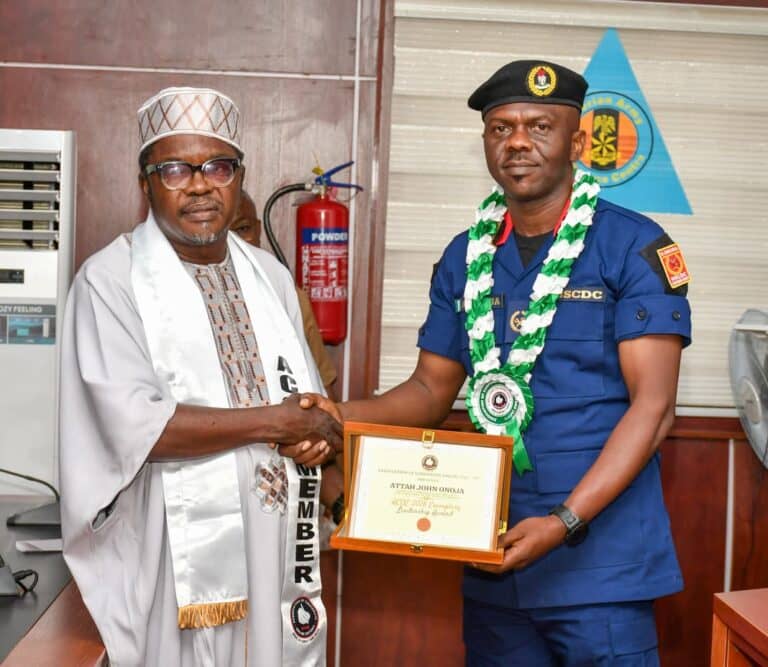
The Nigeria Security and Civil Defence Corps (NSCDC) Mining Marshals Commander, Assistant Commandant Attah John Onoja, on Thursday, November 19, 2026, received an Exemplary Leadership Award from the Association of Corporate Online Editors (ACOE), in recognition of his leadership and contributions to the fight against illegal mining in Nigeria.
ACC Onoja, who also delivered a goodwill message at the ACOE 2026 Annual Lecture and Awards, expressed appreciation to the association for recognising the work of the Mining Marshals, describing the award as an honour not just for him but for officers of the operation and media practitioners who have supported its activities.
The event, held at the Army Resource Centre, was attended by heads of government agencies, parastatals, security organisations, media executives and other stakeholders.

Speaking at the event, Onoja conveyed the goodwill of the NSCDC Commandant-General, Prof. Ahmed Abubakar Audi, who sent his best wishes to the online media practitioners and commended their contributions to national development.
He described online media practitioners as an important part of Nigeria’s media landscape, noting that their work and impact were often visible to the public, even though the challenges they faced behind the scenes were not always appreciated.
Onoja said the Mining Marshals, established about two and a half years ago as an intervention to address illegal mining, had remained committed to blocking revenue leakages, sanitising the mining sector and reducing crimes associated with illegal mineral exploitation.
He disclosed that the operation had arrested at least 850 illegal mining operators since its inception, stressing that its enforcement strategy was designed not only to make arrests but also to deter offenders and encourage compliance with mining laws and regulations.
According to him, the Mining Marshals deliberately adopted unpredictable operational patterns across states to prevent illegal operators from anticipating their movements, thereby strengthening the deterrent effect of their activities despite limited logistics.
Onoja said the success of the operation should not be measured solely by arrests or cases before the Federal High Court but also by the growing compliance of mining operators who had become more cautious about violating regulations.
He revealed that mining-related revenue had risen from about ₦6 billion annually before the intervention to ₦37 billion within a year, with the latest figure reaching ₦101 billion in less than two and a half years.
However, he maintained that the figures could be significantly higher if all stakeholders worked together to address illegal mining and protect the country’s economic interests.
The Mining Marshals Commander also disclosed that the operation had secured convictions in some illegal mining cases, with additional convictions expected before the end of the year, subject to court proceedings.
He urged mining operators to familiarise themselves with and comply with relevant laws and regulations, warning that those operating outside the legal framework risked facing prosecution.
Onoja, however, identified resistance to the operations as one of the major challenges confronting the Mining Marshals, alleging that some vested interests and illegal mining cartels had been making efforts to undermine the operation.
He appealed to journalists to uphold fairness, objectivity and the principles of natural justice when reporting allegations against the Mining Marshals, stressing that individuals and organisations accused of wrongdoing should be given the opportunity to respond.
He said the operation had continued to provide verifiable documentary evidence in response to inquiries from media organisations, rather than relying on verbal explanations, adding that allegations should be properly investigated before conclusions are drawn.
Onoja also cautioned against attempts by individuals facing criminal proceedings to used theother institutions to interfere in matters already before the courts, describing such practices as counterproductive to the fight against illegal mining.
He called on Nigerians to remain patriotic and support efforts aimed at protecting the nation’s economy, insisting that illegal mining posed a serious threat to national revenue, development and economic stability.
He further stressed that the revenue generated from mining activities did not go into the pockets of the Mining Marshals, but was part of the broader national economic gains arising from improved compliance and enforcement.
While expressing gratitude for the award, Onoja dedicated the recognition to officers and men of the Mining Marshals, as well as journalists and other stakeholders who had stood by the operation.
He reaffirmed the readiness of the Mining Marshals to engage the media at any time to clarify issues, provide documents and verify claims, stressing that the collective responsibility of safeguarding Nigeria’s economic future transcended individual institutions.
Onoja urged members of the media and other Nigerians to reflect on their contributions to national development, saying posterity would judge everyone by how they used the opportunities entrusted to them to serve the country.
He concluded by thanking ACOE for the recognition and called for sustained collaboration between security agencies, media practitioners and other stakeholders in the fight against illegal mining.