
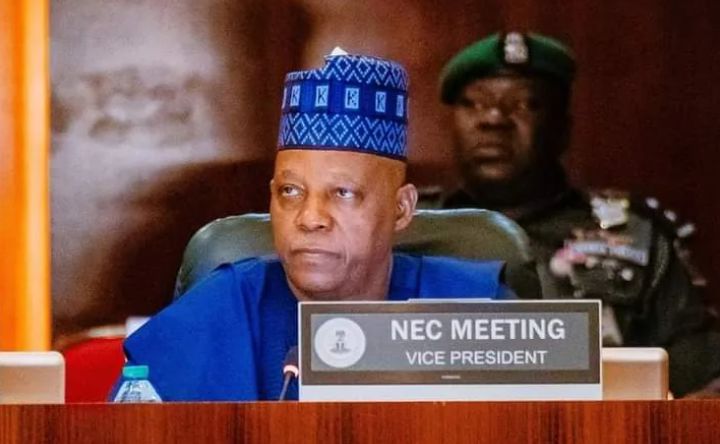
The Federal Government has unveiled a five-year National Drug Control Master Plan (NDCMP) 2026–2030 to strengthen the fight against drug abuse and trafficking, with Vice-President Kashim Shettima calling on all levels of government and other stakeholders to ensure its effective implementation.
Shettima said the plan required urgent action, adequate funding and accountability from federal ministries, departments and agencies, state and local governments, the National Assembly, private sector, traditional and religious institutions and international partners.
Speaking yesterday at the official launch of the plan in Abuja, the Vice-President, who was represented by the Special Adviser to the President on Special Duties, Office of the Vice-President, Dr Modibbo Aliyu Umar, said drug control must remain a national priority.
He said a country could not secure its future without protecting the people responsible for building it, describing the drug problem as a public health concern, security threat, development challenge and economic issue.

According to him, enforcement alone would not address the problem without adequate investment in prevention, treatment and measures to disrupt illicit financial flows sustaining drug markets.
“Our response must therefore be comprehensive, coordinated and sustained,” he said.
The six pillars of the plan include supply reduction, drug demand reduction, access to controlled medicines for scientific and medical purposes, alternative development and sustainable livelihoods, disruption of the illicit drug economy, and governance, financing and coordination.
Shettima commended the leadership of the National Drug Law Enforcement Agency (NDLEA), under Brig. Gen. Mohamed Buba Marwa (retd.), for introducing an Alternative Development programme, which he said was the first of its kind by a drug control agency in Africa.
He directed ministries and agencies to incorporate its priorities into their work plans, budget proposals and implementation schedules.
In his remarks, NDLEA Chairman, Marwa, said the new plan was designed to consolidate previous achievements, address identified shortcomings and respond to emerging threats in the illicit drug trade.
He disclosed that an evaluation of the 2021–2025 master plan recorded 77,736 arrests, the seizure of more than 14.8 million kilogrammes of drugs and over 14,200 convictions.
He added that more than 32,400 people also benefited from treatment, counselling and rehabilitation services during the period.
Marwa said the evaluation identified gaps in coordination, funding, service delivery, data management, monitoring and accountability, as well as weak institutional capacity at state and local government levels.
He said the new plan would address the shortcomings by integrating supply and demand reduction strategies and targeting the financial and technological networks sustaining drug trafficking.
According to him, the measures are necessary to strengthen the country’s response to sophisticated trafficking networks, synthetic drugs, new psychoactive substances and criminal syndicates exploiting encrypted communications and cryptocurrency.