
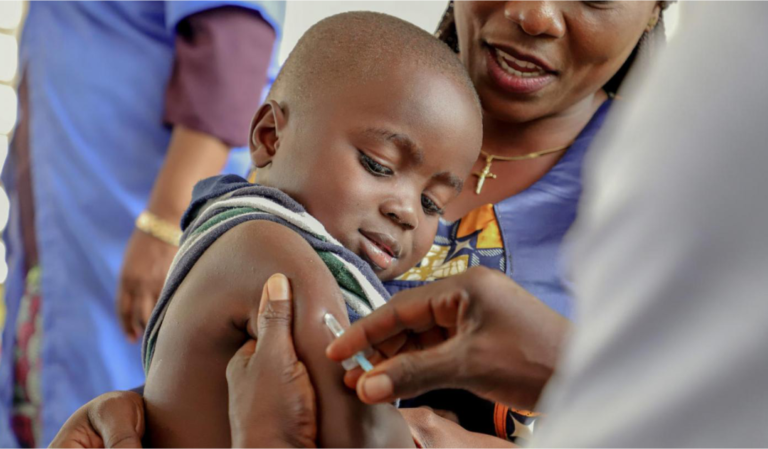
The federal government says it spends approximately $150 million annually on vaccine procurement while expanding malaria vaccination to more states.
The Executive Director of the National Primary Health Care Development Agency (NPHCDA), Muyiwa Aina, stated this on Tuesday during the agency’s first quarterly media briefing for 2026 in Abuja.
Mr Aina said funding for vaccines was sourced from federal government allocations and development partners, particularly Gavi and the Vaccine Alliance.

He said that donors were, however, declining in recent times.
“Countries are now expected to increase domestic financing as global donor resources continue to shrink,” he said.
He explained that vaccine financing covered procurement, outbreak-response, as well as logistics including syringes, waste management systems, incinerators, and cold chain equipment.
According to him, operational costs for nationwide immunisation delivery also form a significant part of government investment.
On malaria control, Mr Aina said that Nigeria had expanded its malaria vaccine rollout from two pilot states, Bayelsa and Kebbi, to include Bauchi and Ondo states based on readiness assessments.
He noted that the malaria vaccine required a four-dose schedule, which presented challenges in ensuring full compliance.
“What is unique about the malaria vaccine is that it requires four doses, and ensuring children return for all doses remains a key challenge,” he said.
He disclosed that Bayelsa State recorded about 68,000 doses administered, Kebbi State 153,000, Bauchi State 66,000, and State over 7,000 doses.
He added that dropouts between doses prompted the government to strengthen tracking and follow-up systems.
Providing updates on vaccine stock and utilisation, he said about 600,000 doses were currently stored in the national cold chain system.
The executive director also said that in the area of coverage, a total of 984,559 children received at least one dose in Kebbi and Bayelsa states, while Ondo State recorded about 166,342 children and Bauchi State about 105,890.
”This brings the total number of children reached to almost 1.3 million,” he said.
He described vaccines as one of the safest and most cost-effective medical interventions available.
According to him, vaccines are much safer and much cheaper than most medicines people buy in stores or use for malaria treatment.
He explained that vaccines undergo rigorous testing and safety evaluation before approval, with benefits far outweighing potential risks.
He added, “Vaccines are highly effective in preventing diseases such as measles. It success often leads to reduced visibility of such diseases in communities.”
He added that while medical interventions, including food and medicines, may have side effects, vaccines remained among the most thoroughly tested and safest preventive tools.
He called for continued public trust in health workers and immunisation programmes, noting that the government was also investing in incentives and staffing to strengthen vaccine delivery.
He reiterated that vaccination programmes often go unnoticed in spite of heavy investment.
Mr Aina further said that beyond immunisation, 48,372 women had accessed free maternal services nationwide, while about 2,497 others benefited from obstetric fistula repair services coordinated through federal facilities and the National Health Insurance Authority.
He described the programme as critical in restoring dignity and improving the quality of life for affected women.
(NAN)