
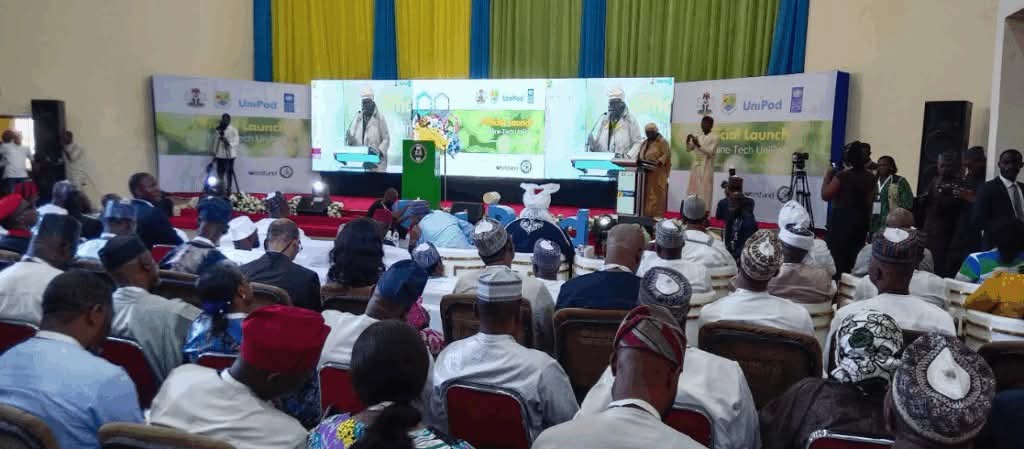
Vice President Kashim Shettima on Friday launched the Mine-Tech University Innovation Pod initiative at Nasarawa State University, Keffi, aimed at driving innovation, research and value addition in Nigeria’s solid minerals sector.
The initiative, developed by the United Nations Development Programme in collaboration with the Federal Government, is designed to support young engineers, geoscientists and entrepreneurs in developing technology-driven solutions for the mining industry.
The launch comes as the Federal Government intensifies efforts to diversify Nigeria’s economy away from oil dependence by repositioning the solid minerals sector as a major contributor to economic growth, industrialisation and job creation.
The event was attended by the Vice Chancellor of Nasarawa State University, Prof. Sa’adatu Hassan Liman; Nasarawa State Governor, Abdullahi Sule; Minister of Education, Tunji Alausa; and the Minister of Solid Minerals Development, Dele Alake, among other dignitaries.

The Mining Technology UniPod at NSUK is a purpose-built innovation space where students, researchers and industry players are expected to collaborate on solutions ranging from safer mining methods to mineral processing and startup development.
Speaking at the event, Vice President Shettima, represented by the Minister of Education, Tunji Alausa, described the initiative as a landmark project that aligns education with industrial development and economic transformation.
“Today’s event is not merely the commissioning of another university facility. It is the unveiling of a broad national vision, a vision that represents Nigerian universities as engines of innovation, commercialisation, enterprise development, and economic transformation,” he said.
He commended stakeholders and strategic partners for supporting the project and praised President Bola Tinubu’s administration for prioritising human capital development, innovation and industrialisation under the Renewed Hope Agenda.
“Education is now being positioned as a strategic national investment for economic growth, job creation, technological advancement, and global competitiveness,” he added.
The Vice President noted that although Nigeria possesses vast mineral resources estimated to be worth over one trillion dollars, the contribution of the solid minerals sector to the country’s Gross Domestic Product remains below expectations.
“For decades, we exported raw materials while importing finished products at a much higher value. We exported opportunities. We exported jobs, technology, and prosperity.
“But today, Nigeria is making a strategic shift from extraction to value addition, from raw material export to industrial processing, from dependence to innovation-driven growth,” he said.
According to him, the Mine-Tech UniPod arrives at a critical time when the global economy is increasingly driven by demand for critical minerals needed for electric vehicles, renewable energy, semiconductors and advanced manufacturing.
Shettima disclosed that seven UniPods had already been established across Nigeria’s geopolitical zones with specialised focus areas, including artificial intelligence recently launched at the University of Lagos.
He explained that the NSUK Mine-Tech UniPod would serve as a collaborative platform for students, researchers, mining professionals, investors and policymakers.
The Vice President highlighted the four major laboratories within the facility, namely the Mineral Intelligence Lab, Material and Processing Lab, Geospatial Innovation Studio, and Green Mining and ESG Technology Hub.
“These facilities represent the future of interdisciplinary learning and innovation. They combine artificial intelligence, machine learning, material science, digital mapping, sustainability, and environmental governance into a single ecosystem for industrial problem solving,” he said.
In his remarks, Governor Abdullahi Sule pledged the state government’s support for the project, promising to provide a solar mini-grid to ensure uninterrupted power supply at the facility.
“Because without providing power, the entire UniPod has become actually less useful. You must have the power to make it useful, and the power must be sustained,” he said.