
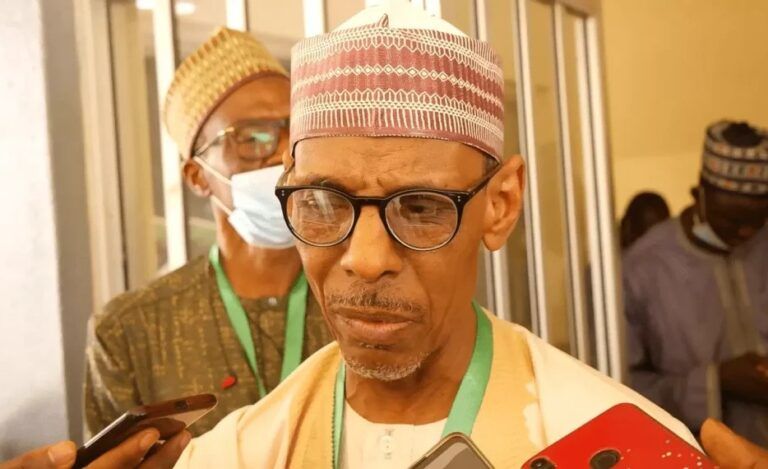
The National Chairman of the Peoples Redemption Party (PRP), Hakeem Baba-Ahmed, has predicted that President Bola Tinubu and the ruling All Progressives Congress (APC) may find it difficult to win more than two or three states in Northern Nigeria during the 2027 general elections if the exercise is free, fair and credible.
Baba-Ahmed attributed the party’s possible poor performance to growing dissatisfaction with the Tinubu administration, particularly over insecurity, economic hardship and the increasing cost of living, which he said could weaken the president’s chances of re-election.
The former Special Adviser to Tinubu on Political Matters made the prediction on Wednesday during an interview on Trust TV’s Daily Politics, hosted by Hamza Idris.
He said his assessment reflected the current public perception of the ruling party, arguing that the APC had lost significant public confidence and might struggle to regain it before the next general elections.

“On the basis of the current disposition of the public towards APC at all levels, it will be a miracle if they genuinely win two or three states in the North,” he said.
The PRP chairman also predicted that the APC could record major electoral losses in other parts of the country.
He said he would not be surprised if the ruling party lost all five states in the South-East, won only two or three states in the South-South and possibly secured just two states in the South-West.
He further projected that the party could lose considerable support in the North-Central geopolitical zone.
His prediction comes amid increasing political realignments and efforts by opposition parties to form a strong coalition capable of challenging the APC in 2027.
Baba-Ahmed questioned the assurances from some governors and political allies who had promised to deliver millions of votes for Tinubu in the next election.
According to him, such commitments might not reflect the actual political realities in their states, warning that the president could be receiving misleading assurances from associates who were also facing public dissatisfaction.
“On what basis would you promise two million votes? On what basis?” he asked.
He argued that some governors making such promises were disconnected from the feelings of ordinary Nigerians, adding that their assurances could give the president a false sense of electoral security.
The PRP leader also faulted the president’s reliance on political mobilisation and endorsements, maintaining that the true measure of popularity was whether voters were willing to support the ruling party during elections.
He referred to attendance at some of Tinubu’s political rallies, including one held in Jos, Plateau State, as evidence of what he described as declining public enthusiasm for the president.
Baba-Ahmed urged Tinubu and his supporters to pay closer attention to Nigerians’ actual reactions to the administration instead of depending solely on reports from governors and political appointees.
He also accused Northern governors of failing to adequately present the region’s worsening security challenges to the president.
He said governors and other political leaders in the region should have jointly approached Tinubu earlier in his administration to brief him on the extent of insecurity affecting communities across Northern Nigeria.
According to him, banditry, kidnapping, killings and religious extremism have continued to endanger lives and livelihoods, with some communities reportedly living under the influence or control of armed groups.
He maintained that the government’s failure to tackle the situation decisively had further eroded public confidence.
Baba-Ahmed equally criticised the administration’s management of the economy, particularly the hardship caused by rising living costs and the difficulties households face in meeting their basic needs.
He said ordinary Nigerians were increasingly struggling with economic conditions, especially in the North, where insecurity and limited economic opportunities had worsened the impact of the country’s financial challenges.
The former presidential adviser said the administration had failed to fulfil the expectations it raised when it assumed office in May 2023.
He added that the government’s acknowledgement of the country’s economic and security problems came too late to reverse the growing dissatisfaction among citizens.
“There is a time to make amends. And there’s a time when it’s too late,” he said.
On the opposition coalition, Baba-Ahmed expressed optimism that discussions aimed at bringing political parties and influential figures together against the APC were making progress.
He revealed that the coalition had developed three major policy documents covering different aspects of the programme it intends to present to Nigerians if it wins power.
He dismissed fears that disagreements among opposition leaders over the selection of a presidential candidate could threaten the alliance, insisting that members understood the importance of compromise.
However, he warned that the opposition was operating in what he described as a hostile political environment, making it important for its leaders to exercise caution in revealing their strategies.
He said the coalition’s main objective was to offer Nigerians a credible alternative to the APC and achieve a change of government in the 2027 general elections.