
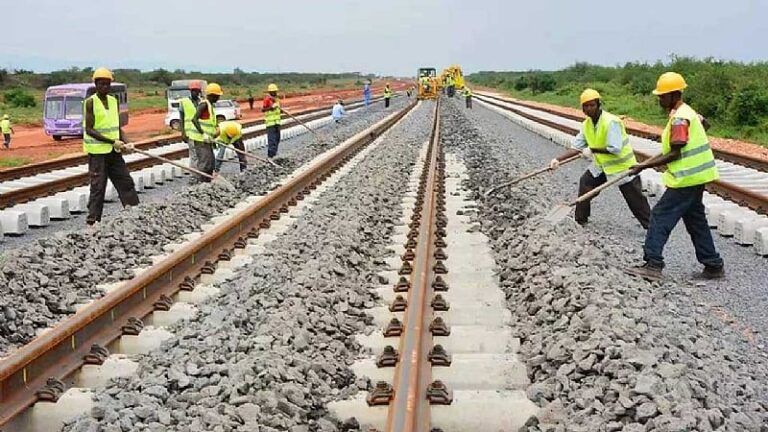
The Federal Government has expressed satisfaction with the progress of work on the Kaduna–Kano rail project, saying construction of the railway and its stations has reached an advanced stage ahead of its planned December inauguration.
This was disclosed in a statement issued on Friday in Abuja by the Assistant Director of Press and Public Relations in the Federal Ministry of Transportation, Osima Seddon.
According to the statement, the ministry’s Permanent Secretary, Funso Adebiyi, spoke during an inspection tour of the project involving officials of the Debt Management Office (DMO) and other senior government officials. The team travelled by train from Jaji in Kaduna State to the Kano Terminal Station.
Adebiyi described the journey as smooth and impressive, adding that the Kano terminal station was almost ready, with only the installation of its name signage remaining. He said the signage would be installed within two weeks.

He recalled that during an earlier inspection, he had identified some areas requiring improvements, not because of poor performance by the contractors, but to ensure the project met the highest standards. He expressed satisfaction that the concerns had been addressed.
Among the improvements was the replacement of toughened glass with laminated glass in areas accessible to passengers. Adebiyi explained that laminated glass provides better safety because it does not break into potentially dangerous fragments under certain conditions. He added that only the damaged section would need replacement if it was affected.
He also said he had directed that lighting bulbs installed at the stations should have a minimum lifespan of three years, noting that the contractors had replaced the bulbs to meet the required standard.
Other improvements included the installation of man-lifts to support maintenance work and plans to train Nigerian Railway Corporation (NRC) engineers in station operations.
The permanent secretary said the NRC had been asked to nominate engineers for the training, which he would personally attend. He stressed that only those who successfully passed the required examinations would be retained to operate the facilities.
On the commencement of commercial services, Adebiyi disclosed that the ministry was proposing a three-month trial operation of the railway from Jaji to Kano, possibly offering free passenger services, subject to President Bola Tinubu’s approval.
He explained that the trial period would allow the government to evaluate the structural condition and operational performance of the railway before full commercial activities begin.
Adebiyi expressed confidence in the quality of the track infrastructure, citing the smooth journey during the inspection. He noted that passengers could comfortably drink tea, take soft drinks and eat without experiencing significant vibrations or shaking.
On accessibility, he said facilities had been provided for persons with disabilities following observations made during his previous inspection. He disclosed that about four lifts had been ordered, while an additional staircase had been constructed at the rear of the terminal.
He added that railings for the staircase had also been imported to ensure safe and convenient movement within the facility.
Describing the Kano terminal station’s waiting hall as exceptional, Adebiyi said it could be ranked among the best railway terminal facilities in Africa. He also praised the contractors for the quality of work delivered.
Addressing the outstanding connection between Kaduna and Kano, he explained that security concerns around Jaji had necessitated a horizontal curve in the railway alignment, leading to the construction of a bridge.
According to him, the bridge, which is being constructed in-situ, is nearing completion and represents the major remaining infrastructure between the Jaji section and the connection to Kaduna.
He said track-related work had reached the bridge embankment, adding that rail installation would begin once the structure was completed.
Adebiyi further disclosed that the Kaduna train station, where passengers would disembark, was being expanded to accommodate the expected increase in passenger traffic.
He also revealed that work was ongoing on another railway corridor from Kano through Kazaure, Daura and Katsina.
Although the project had faced some land acquisition challenges between the Kano station and Dawano, he said construction along the route from Dawano through Kazaure and Daura to Katsina was progressing.
Providing an overview of the Federal Government’s railway development programme, Adebiyi said the Kaduna–Kano corridor was part of an integrated national railway network designed to connect major commercial and industrial centres across the country.
He explained that the railway network began from Apapa in Lagos, allowing 40-foot containers to be transported by rail to Ibadan, where a dry port provides cargo clearance services.
He added that the wider connectivity plan would link Abuja to Kaduna, Kaduna to Zaria, Zaria to Kano and extend further through Kazaure, Daura and Katsina.
According to him, the government is implementing the railway programme as an interconnected national infrastructure project rather than as separate developments.
Adebiyi expressed optimism that when the planned connections are completed, passengers would be able to travel by rail from Warri through Kano, Katsina, Daura and Kazaure, with further connections from Katsina to Jibia and Maradi in the Niger Republic.
Also speaking during the inspection, the Director-General of the Debt Management Office, Patience Oniha, said the agency played an important role in providing funding and financing support for government capital projects.
She explained that the visit was organised to enable the DMO leadership to assess and appreciate progress on infrastructure projects funded by the government.
Recalling an earlier visit when the team travelled by road from Kaduna to Kano, Oniha said the latest inspection provided an opportunity to experience the rail journey from Abuja through Kaduna and Jaji to Kano.
She described the project as excellent and commended the Federal Ministry of Transportation and the contractors for their commitment and dedication to its successful completion.
Meanwhile, the CCECC Project Coordinator, Mark Xu, and the Project Manager of Team Nigeria Consultants, Precious Ebare, reaffirmed their commitment to ensuring rapid progress while maintaining strict compliance with international design specifications.
Both representatives said continuous quality assurance and the prompt implementation of corrections identified during previous inspections had kept the project on course for successful and timely handover to Nigerians.
NAN