
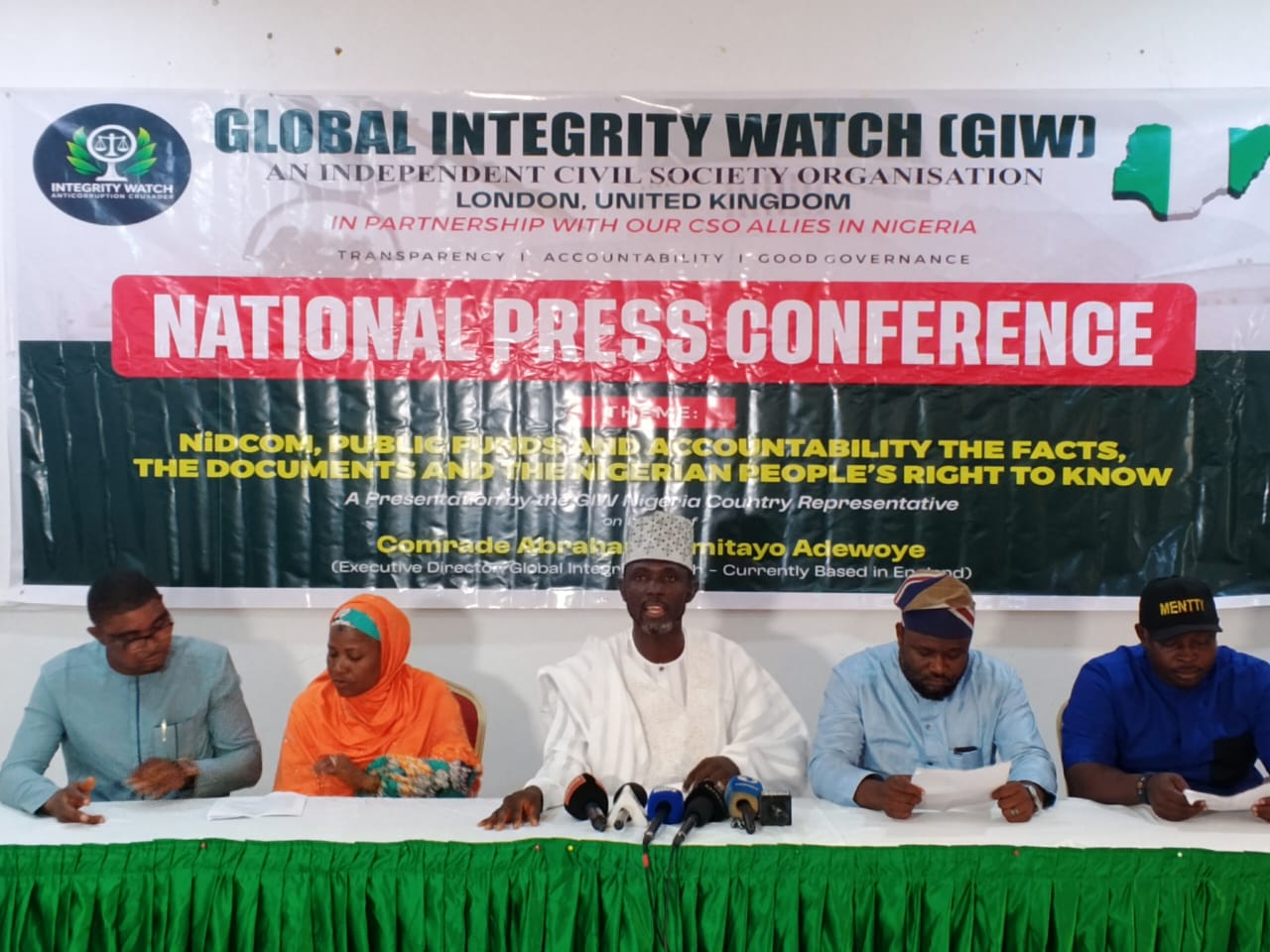
Global Integrity Watch (GIW), has raised fresh questions over approximately ₦1.409 billion in quantified audit observations involving the Nigerians in Diaspora Commission (NiDCOM), demanding access to the commission’s 2023, 2024 and 2025 financial records to establish how the issues were addressed.
The civil society organisation also announced the launch of the New Nigeria Public Accountability Initiative (NNPAI), through which it said it would investigate unresolved Auditor-General’s findings, financial non-compliance, weak internal controls and failure by public institutions to implement audit recommendations.
Spokesperson of GIW Nigeria, Comrade Tijani Abdulmumin, disclosed this in Abuja during a press briefing on the organisation’s latest engagement with NiDCOM following a Freedom of Information (FOI) request.
The development comes after NiDCOM reportedly responded to GIW’s FOI request by relying on Section 12 of the Freedom of Information Act 2011 to decline access to some additional records.

Abdulmumin said the commission also described its campaign as “blackmail and witch-hunting”, a characterisation the organisation strongly rejected.
He said that the organisation’s objective was not to target individuals but to strengthen institutions through evidence-based public accountability.
Abdulmumin said: “Our commitment to fighting corruption and promoting accountability is non-negotiable. We will follow the evidence, allow institutions to respond and ensure that credible public-interest concerns receive the attention they deserve.
“Speaking after GIW’s executive meeting in London on 17 August 2026, Executive Director Comrade Abraham Temitayo Adewoye said: GIW emphasises that NNPAI is not about targeting individuals, but about strengthening institutions and protecting the public interest. GIW will distinguish between audit findings, allegations and facts before publishing its findings.”
GIW said its review of available material relating to the Auditor-General’s Report on Non-Compliance for the 2023 audit period identified quantified observations amounting to approximately ₦1.409 billion.
The organisation was, however, careful to stress that the figure represents an aggregate of audit-observation amounts and is not being presented as evidence that ₦1.409 billion was stolen or misappropriated.
Among the issues identified, according to GIW were, ₦340.827 million relating to alleged circumvention of procurement procedures, ₦137.524 million involving alleged splitting of contracts and ₦165.292 million in contracts involving questioned tax-clearance documentation.
Others included ₦91.903 million involving contractors whose financial capacity was questioned and ₦356.383 million involving companies with expired prequalification documents.
Abdulmumin also cited ₦6.092 million in reported contractor overpayments for which recovery was recommended; ₦209.085 million in payments for which adequate evidence of execution was reportedly not produced; ₦16.434 million in reported tax under-deductions; and ₦15.6 million identified in the audit material as misapplication of funds.
The organisation further listed ₦48.905 million involving payments allegedly made to officers other than named beneficiaries and ₦20.548 million in cash advances above the approved limit.
He also raised questions over five vehicles recorded in NiDCOM’s books but reportedly not sighted during physical verification.
He said the issues required explanations, reconciliation and documentary verification and, where applicable, recovery.
The organisation said its central concern was not to pronounce anyone guilty but to establish what happened after the Auditor-General’s observations were raised.
Abdulmumin added, “Were the questioned payments properly authorised? Were procurement procedures followed? Were the contracted goods and services actually delivered? Were taxes properly deducted and remitted? Were recommended recoveries made? Were the five vehicles subsequently located and verified?
“What management responses were ultimately submitted to the Auditor-General and relevant oversight bodies? According to GIW, answers to those questions should be established through documentary evidence rather than media exchanges.
“The organisation said it rejected any suggestion that asking questions about an Auditor-General’s report and requesting supporting documents under the FOI Act constituted blackmail.
“An audit observation is not automatically proof of corruption or misappropriation. Our responsibility is to identify accountability questions, request explanations, examine the evidence and report the position fairly.”
He also noted that NiDCOM had supplied a Nigeria Police Force interim investigation report concerning a reported burglary and theft in July 2024.
According to the organisation, the report documented the theft of computers, a hard drive, a flash drive and files containing procurement and other official documents.
GIW argued that the disappearance of physical records should not automatically end questions about public expenditure.
Abdulmumin said it would approach relevant federal institutions to determine whether electronic backups, duplicate records, registry entries, financial-system records or copies earlier submitted to other government institutions could be recovered.
He said it was formally seeking NiDCOM’s 2023, 2024 and 2025 Annual Reports and Financial Statements, alongside relevant audit reports, management responses and supporting financial and procurement records.
He said the records were necessary to conduct an independent forensic review and determine which issues had been resolved, which transactions reconciled and which accountability questions remained outstanding.
He said he would examine a February 1, 2024 document from the Ministry of Foreign Affairs supplied by NiDCOM concerning an earlier petition.
He said the document indicated that the ministry had examined the earlier petition and concluded that the allegations could not be substantiated.
The organisation said it acknowledged the document and would consider it in its assessment, while maintaining that an earlier administrative review did not prevent an independent examination of separate Auditor-General observations.
He called on the NiDCOM leadership, headed by Hon. Dr. Abike Dabiri-Erewa, to provide Nigerians with the highest possible level of lawful transparency on the outstanding accountability questions.
He said where a public institution could no longer demonstrate adequate transparency and accountability to the public it serves, the appropriate appointing and oversight authorities should consider whether new leadership was required to restore public confidence and strengthen institutional controls.
The organisation stressed that its position was not based on personal hostility, saying that, “It is based on the principle that public office is a public trust and must be exercised in the interest of the Nigerian people.”
He also expressed support for the economic reforms of President Bola Ahmed Tinubu, arguing that macroeconomic reforms must be matched by stronger accountability within individual public institutions.
He said the President could not personally monitor every transaction and administrative decision across the country’s numerous public institutions.
The organisation therefore argued that independent civil-society scrutiny could help bring credible documentary concerns to the attention of government and the public.
“GIW’s objective is to support good governance by identifying potential weaknesses, requesting evidence and encouraging corrective action—not to undermine legitimate government reforms,” it said.