
By Emmanuel Awari -Jalingo
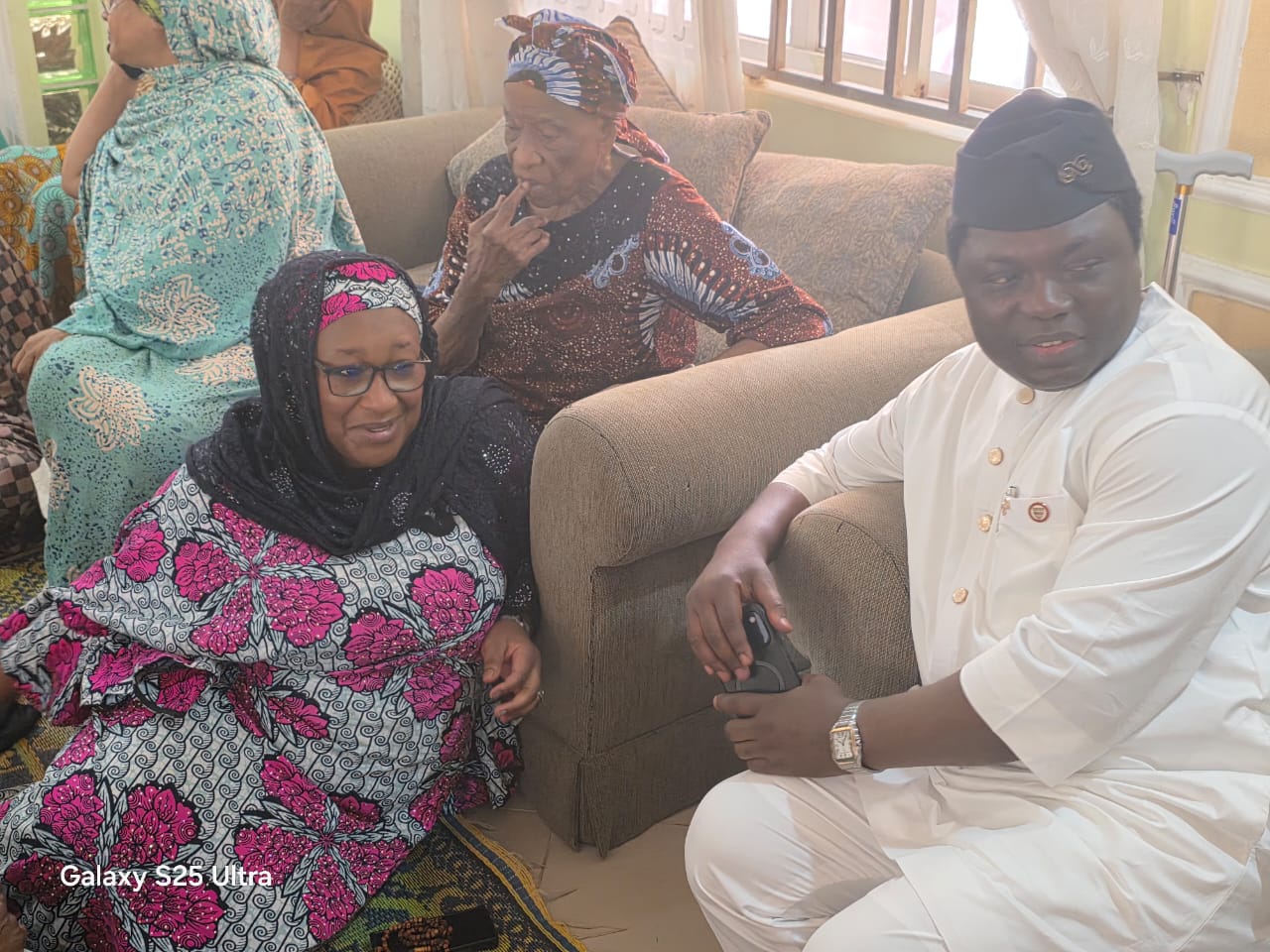
Taraba State Governor, Dr. Agbu Kefas, has visited Yola, Adamawa State, to condole with the family of the late elder statesman and former Governor of the defunct Gongola State, Alhaji Bamanga Muhammad Tukur in Yola, the Adamawa state capital.
Gov Agbu Kefas, who led a delegation of senior government officials and political leaders from Taraba State, described the passing of the distinguished statesman as a profound loss to Adamawa State, Taraba State, and Nigeria at large.
The Governor expressed solidarity with the bereaved family, praying Almighty Allah to forgive the deceased’s shortcomings and grant him Aljannatul Firdaus.

The Governor was accompanied by the Speaker of the Taraba State House of Assembly; Rt. Hon. John Kizito Bonzena, the Majority Leader; Hon. Jethro Yakubu Zikengyu, APC State Chairman, Alhaji Abubakar Bawa, Secretary to the State Government; Chief GT Kataps, Esq., Head of Service; Dr. Hamidu Ahmed Kara, Hon. Kabiru Jalo, Hon. Habu Isa Ajiya, and APC Organising Secretary, Mr. Edward Bobzon.
The visit highlighted cross-border respect for a shared political and historical figure whose legacy continues to resonate across the former Gongola territory.
Late Bamanga Muhammad Tukur spent more than five decades in Nigerian public life, moving between business, administration and politics.
He was a governor, minister, businessman, technocrat and national chairman of the Peoples Democratic Party (PDP).
By the time he died on Saturday at the age of 90, Tukur had served under civilian and military administrations, headed the Nigerian Ports Authority (NPA), governed the old Gongola state, occupied a federal cabinet position and led the PDP when it was Nigeria’s ruling party.
His career spanned some of the defining moments in Nigeria’s political and economic history.
He entered public service before independence, rose through the transport sector to become NPA chief, took charge of the ports during the “cement armada” crisis, entered electoral politics and later became a prominent figure in African business circles.
His death brings to an end the career of one of Nigeria’s most enduring public figures and one of the final links to the country’s Second Republic.
Tukur was one of the four surviving governors of Nigeria’s second republic. With his death, only three remain: Jim Nwobodo of Anambra, Awwal Ibrahim of Niger and Asheik Jarma of Borno.
In the foreword to a 2021 collection of Tukur’s speeches, Gowon described him as a workaholic, in reference to Tukur’s work ethic, a quality that resonates in how people described him.
Tukur remained at the NPA until 1982.
Following the military takeover, Tukur returned to the private sector and founded BHI Holdings, also known as the Daddo Group of Companies.
He also became more active in African business circles. Tukur founded and served as executive president of the African Business Roundtable (ABR), which brought together business leaders and policymakers around the continent to promote private-sector development, regional trade and economic integration.
Through the platform, he advocated closer economic cooperation among African countries and greater involvement of the private sector in the continent’s development. He was also the chairman of the NEPAD Business Group.
He was also involved in international maritime organisations and held positions connected to port management and investment.
In the late 1970s, Tukur became the first African to serve as vice-president of the International Association of Ports and Harbours (IAPH), a global body representing ports and maritime interests.
He was also involved with the Nigerian Railway Corporation and other public and private sector bodies, drawing on the transportation expertise that had characterised his early career.
In a 2025 tribute to mark Tukur’s 90th birthday, Adebayo Sarumi, a former NPA chief executive, said Tukur’s vision for regional integration, trade facilitation and good governance “directly contributed to the conceptual foundation of the African Continental Free Trade Area (AfCFTA)”.
Tukur with former President Goodluck Jonathan at the inauguration of National PDP Councillors’ Forum in Abuja in 2013
In March 2012, at the age of 76, Tukur assumed leadership of the Peoples Democratic Party (PDP) as its national chairman.
The appointment placed him at the head of Nigeria’s then dominant political party and made him one of the most powerful political figures in the country.
The PDP had controlled the presidency since 1999 and was the dominant political organisation in Nigeria.
Tukur therefore took charge of a party at the height of its national influence, but also at the beginning of one of its most serious internal crises.
His tenure suffered an internal crisis as disagreements between the party’s leadership and some of its governors, lawmakers and influential members intensified.
In 2013, seven governors, 22 senators and 57 members of the house of representatives broke away to form what became known as the New PDP.
Former Vice-President Atiku Abubakar was among the prominent figures associated with the faction.
The crisis weakened the party ahead of the 2015 general election, which it eventually lost to the All Progressives Congress (APC).
There were calls for Tukur’s resignation, but he insisted that only the party’s convention could remove him.
He eventually resigned as PDP national chairman in January 2014, ending less than two years at the helm of the ruling party.
He was subsequently appointed ambassador-at-large by then President Goodluck Jonathan.
On his 80th birthday, Tukur announced that he was retiring from partisan politics.
He said he wanted to leave partisan politics to younger Nigerians and serve instead as a statesman and adviser.
“It is time to say goodbye to formal politics,” he said.
“I have used several political platforms to serve my country.
It is time to rest.”
“At the age of 80, I feel I can serve our dear nation more in the capacity of a statesman and father figure.”
He also urged politicians to treat politics as service rather than a means of personal gain.
For more than five decades, Tukur’s movement spanned spheres of life; each chapter took him into a different arena, but the work ethic that earned him the name “Sarkin Aiki” remained constant.