
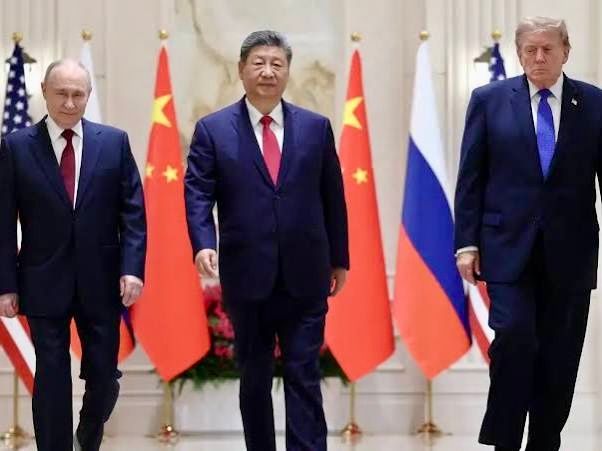
Mixed reactions have continued to trail the historic meeting between Chinese President Xi Jinping, United States President Donald Trump and Russian President Vladimir Putin in Shenzhen, China.
The trilateral meeting, tagged “Trump–Xi–Putin”, was held on Thursday on the sidelines of the Asia-Pacific Economic Cooperation (APEC) Summit.
Analysts described the gathering as an unprecedented diplomatic event that could strengthen global stability and provide an opportunity to address lingering international security challenges.
They identified the Russia-Ukraine war, freedom of navigation in the Strait of Hormuz, the ongoing Gaza crisis and the need to strengthen global supply chains as some of the major issues that could feature in discussions.

The meeting is also expected to address global geopolitical tensions and efforts to stabilise the existing world order.
Some observers described the gathering as a G-3 superpower summit that could offer new opportunities for Africa, particularly by changing how African countries engage with major world powers.
Chinese Foreign Ministry spokesperson Mao Ning described the meeting as a landmark development that could make significant contributions to international peace and stability.
Mao said the three leaders would exchange views on protecting global peace and strengthening strategic stability in relations among major powers.
She added that China, Russia and the United States had an important responsibility to work together in addressing global challenges and promoting international stability.
The significance of the meeting is further underscored by the fact that the three countries are founding members of the United Nations and permanent members of its Security Council.
Available figures also indicate that their combined trade in goods reached $807 billion in 2025. China-US trade accounted for more than 70 per cent of the total, China-Russia trade represented about 28 per cent, while trade between the US and Russia was below one per cent.
The three countries also fought together during the Second World War to defeat fascism.
Analysts said the meeting could provide an opportunity for the countries to improve communication, manage their differences and strengthen relations, while working together to address international challenges.
They added that the engagement could benefit the three countries, meet the expectations of the international community and contribute to global stability through increased dialogue and cooperation.
Russian presidential aide Yury Ushakov said the meeting had become necessary despite existing differences, particularly to address concerns among developing countries about possible conflicts of interest among the three powers and establish a common direction for the future.
However, Xiaoyu Pu, an associate professor of political science at the University of Nevada, described the gathering as more symbolic than significant from the perspective of great-power diplomacy.
Meanwhile, other experts urged African leaders to draw lessons from the historic engagement and use similar diplomatic opportunities to advance the continent’s development.
Dr Collins Nweke, author of Economic Diplomacy of the Diaspora, said the meeting offered an important example for African countries, noting that China had used its position as host of the APEC Summit to facilitate separate diplomatic engagements with Washington and Moscow.
Nweke, who is also a global affairs analyst, explained that the APEC Summit brought together advanced industrial economies, emerging markets and developing countries, reflecting the region’s economic diversity.
He advised African governments to adopt similar strategies by using major international gatherings to bring together political leaders, investors and development banks to discuss issues affecting the continent and negotiate practical solutions.
According to him, Nigeria and other African countries should engage all major world powers based on their own priorities and cooperate whenever their interests align.
He said such an approach would help Africa strengthen its influence in an evolving global order.
Stakeholders also described the Shenzhen meeting as a test of whether rival global powers could manage their competition without allowing it to escalate into more dangerous confrontations.
They noted that Washington was interested in opening discussions on nuclear arms, adding that the engagement could produce positive outcomes if the leaders committed to sustained dialogue, information sharing and improved communication during crises.
They further expressed optimism that the meeting could lead to practical measures to reduce tensions in the Gulf and ensure that countries directly affected by regional conflicts have a say in decisions concerning their future.