
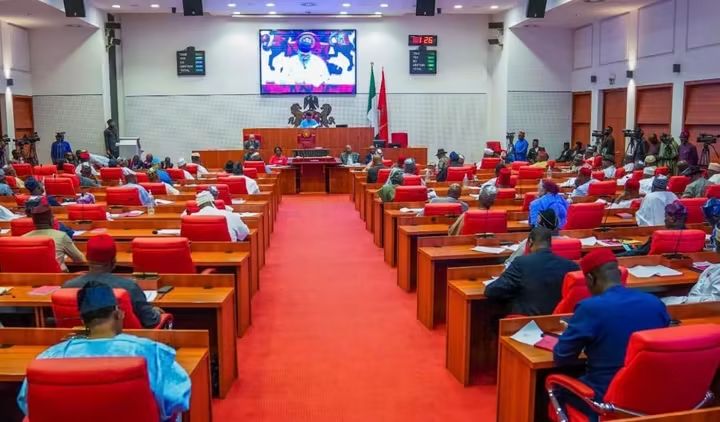
The senate has passed for second reading two bills seeking to increase the number of judges of the federal high court and justices of the court of appeal as part of efforts to improve justice delivery and reduce case backlogs.
The bills, sponsored by Opeyemi Bamidele, the senate leader and senator representing Ekiti central, were consolidated and debated together during Tuesday’s plenary.
Leading the debate, Bamidele said the judiciary must be adequately equipped with the human and material resources required to discharge its constitutional responsibilities effectively.
The senate leader described the federal high court as a strategic institution within Nigeria’s judicial architecture, noting that it exercises exclusive jurisdiction over matters relating to taxation, customs, banking, aviation, telecommunications, immigration, intellectual property, money laundering, terrorism financing, oil and gas operations and elections into certain offices.

Bamidele said the court’s workload has increased significantly over the years due to the expansion of economic activities, technological advancement, cybercrime, anti-corruption prosecutions and the growing complexity of governance.
According to him, the existing number of judges at the federal high court had become inadequate, resulting in congested dockets, delays in the hearing of cases and rising litigation costs.
“It is imperative that our judicial institutions evolve in response to contemporary realities,” he said.
“The judiciary remains one of the three coequal arms of government and must be adequately supported by the government.”
Bamidele said the bill seeks to increase the number of judges of the federal high court from 70 to 90.
According to him, the proposal would help reduce the backlog of cases, improve access to justice, strengthen anti-corruption prosecutions, boost investor confidence and improve the administration of justice in specialised sectors.
“It is a strategic intervention aimed at strengthening the capacity of the federal high court to meet the growing demand of a dynamic and rapidly evolving nation,” he said.
Tahir Monguno, senate chief whip and senator representing Borno north, supported the proposal.
Monguno said the federal high court had long advocated an increase in the number of judges to cope with its expanding jurisdiction.
“Justice delayed is justice denied, and justice should not only be done, but to be seen manifestly to be done,” he said.
“So, in order to hasten the quick dispensation of justice and bring justice to the doorsteps of the citizenry, there is a need to support this bill.”
On the second bill, Bamidele said the court of appeal occupies a strategic position within the Nigerian judiciary but has become overstretched due to the growing volume of appeals from courts and tribunals across the country.
He argued that the current number of justices is no longer sufficient to cope with increasing electoral disputes, commercial litigation, institutional cases and other appeals.
“The consequence has been a substantial backlog of cases, prolonged delays in the hearing and determination of appeals and increased pressure on judicial officers,” he said.
The senate leader said the bill proposes increasing the number of justices of the court of appeal from 70 to 110.
He added that the legislation would also provide for the integration of virtual court proceedings and establish an alternative dispute resolution centre within the court.
“Another salient provision of this bill is the introduction of virtual court proceedings, which many jurisdictions across the world have institutionalised due to its effectiveness and expediency during the COVID-19 pandemic,” he said.
“Another innovative provision of the bill is the establishment of an alternative dispute resolution centre within the court of appeal.”
“This mechanism has become indispensable to reducing court congestion and encouraging amicable settlement of disputes.”
Onyekachi Nwebonyi, senator representing Ebonyi north, also backed the bill.
“The reason behind this bill is not far-fetched. Considering the workload before the Court of Appeal, it goes without saying that there is a need to increase the number of judges in that court,” Nwebonyi said.